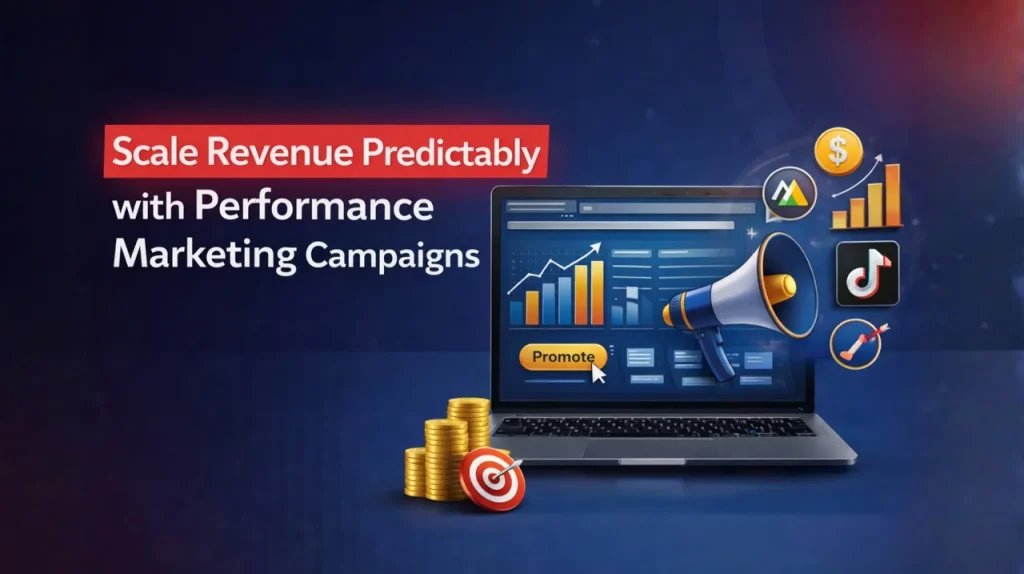
When used consistently, performance marketing transforms advertising expenditure into a predictable outcome. ROI-driven marketing is an approach that connects expenditure, measurement, and creativity with the sole purpose of profitably increasing sales and lifetime value.
In this blog, we look at how performance marketing, when built around revenue outcomes, becomes a powerful engine for sustainable business growth.
Why Does this Approach Matters Now?
Outcome accountability is replacing impression-centric action in market dynamics. Measurable, outcome-first projects are the most evident way to expand in 2026 and beyond, according to industry study.
Furthermore, predictable growth is distinguished from noisy spend by deliberate orchestration across channels, data, and automation.
Core Elements of a Revenue-First Program
- Clear, monetized goals
Set target CPA (Cost Per Acquisition)/ROAS (Return on Ad Spend) based on economics, not vanity metrics. - Full-funnel instrumentation
Track exposures through conversion and into repeat purchase. - Audience and creative testing
Rapid A/B cycles to find the message that converts at scale. - Automated allocation
Shift budget toward initiatives that meet profitability thresholds in real time.
These building blocks are the practical backbone of a robust paid plan, and they’re central to modern paid media strategy, The Scale Performance.
Four Tactical Steps to Make Revenue Predictable
- Model economics first.
Define target customer lifetime value and allowable acquisition cost. - Map channels to funnel stages.
Use search for intent capture, social for prospecting, and retargeting for conversion. - Run hypothesis-led tests.
Prioritize creative and landing-page experiments that improve conversion rates. - Automate signal-driven bidding.
Use rule-based or machine learning bidding so capital chases performance, not gut.
These steps create a repeatable loop where data informs spend and spend produces measurable revenue.
Quick KPI Table
| KPI | What it shows | Action trigger |
| Target CPA / CPA | Acquisition efficiency | Pause or optimize channels above threshold |
| ROAS / Return on Ad Spend | Immediate profitability | Scale channels ≥ target ROAS |
| LTV (Customer Lifetime Value): CAC (Customer Acquisition Cost) ratio | Long-term viability | Adjust acquisition aggressiveness |
| Conversion rate | Funnel health | Prioritize CRO (Conversion Rate Optimization) for highest-impact pages |
Data Turns Marketing into a Growth System
Performance marketing’s dependence on quantifiable insights is one of its biggest benefits. Decisions are based on real-time campaign data rather than speculation.
This analytical approach allows organizations to:
- Prioritize high-performing channels
- Allocate budgets based on results rather than estimates
- Identify bottlenecks in the customer journey
- Continuously refine messaging and targeting
- Generate leads fast through optimized campaigns and precise audience targeting
As campaigns evolve, this feedback loop ensures marketing investment consistently improves over time.
How this Reduces Risk and Accelerates Growth?
Every optimization has a financial impact when campaigns are linked to certain revenue outcomes. Teams may confidently expand winners and swiftly eliminate underperformers by implementing ROI-driven marketing strategies.
One-time successes become consistent monthly growth when conversion-first creativity is combined with methodical measurement.
Conclusion
Predictable growth rarely happens by chance. It is the product of rigorous marketing based on measurement, experimentation, and ongoing improvement. Revenue-driven performance marketing achieves this structure by tying every campaign, channel, and budget choice to measurable results. When marketing spending are directed by actual data and defined performance targets, scaling becomes significantly more manageable and effective.
Looking to scale revenue with greater precision? Connect with our team to explore how a strategic performance marketing framework can drive measurable growth.