
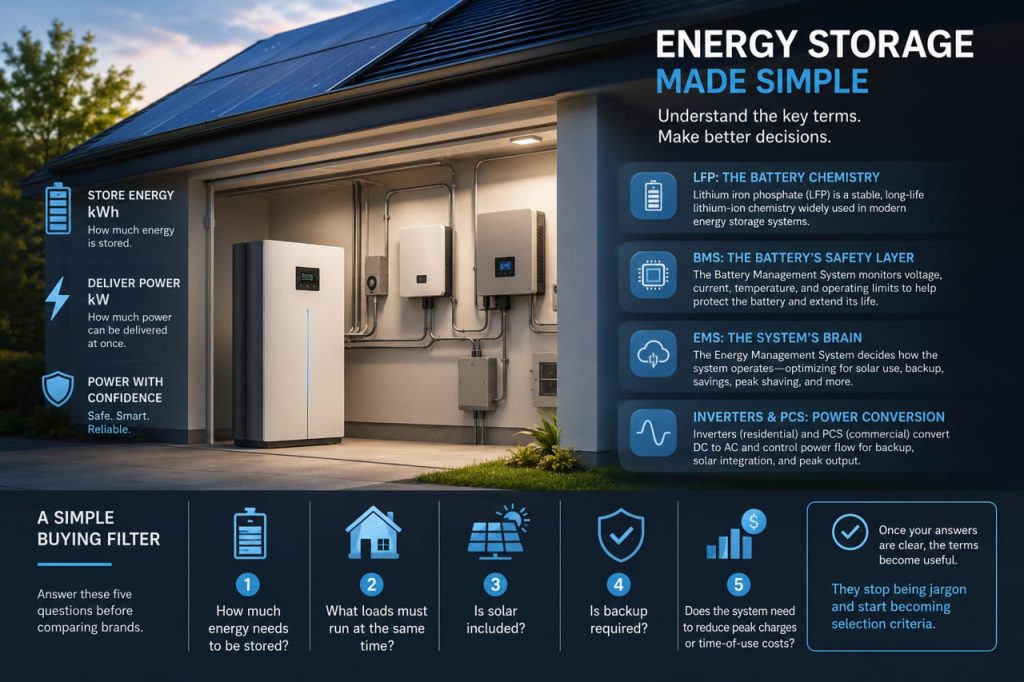
Energy storage has a vocabulary problem. A buyer may start with a simple goal, such as backup power or lower bills, then run into LFP, BMS, EMS, PCS, kW, kWh, and hybrid inverters. The terms are useful, but only if they connect to real decisions.
LFP: The Battery Chemistry
LFP stands for lithium iron phosphate. It is a type of lithium-ion battery chemistry commonly used in stationary storage. Buyers often see it in home batteries and commercial systems because it is known for stable operation and long cycle life.
Battery chemistry matters, but it is not the whole system. The same chemistry can perform differently depending on thermal design, controls, installation, and usage.
kW and kWh Are Not the Same
Kilowatt-hours, or kWh, measure stored energy. Kilowatts, or kW, measure power output.
A 10 kWh battery might run small loads for many hours, but it cannot necessarily start every large appliance. The inverter output determines what can run at the same time.
This distinction is critical for both homeowners and businesses. A home may need surge support for a pump. A business may need enough output to reduce a demand spike.
BMS: The Battery’s Safety Layer
The battery management system monitors internal battery conditions. It watches voltage, current, temperature, and operating limits. If the battery moves outside safe conditions, the BMS helps protect the system.
A strong BMS is one reason modern battery energy storage systems can be monitored and controlled more intelligently than older battery banks.
EMS: The System’s Brain
The energy management system decides how the system behaves. It may prioritize solar self-consumption, backup reserve, time-of-use savings, peak shaving, or generator coordination.
For example, ESYsunhome’s APP and Cloud are designed around energy flow monitoring, remote control, and smart energy management. That software layer matters because a battery’s value depends on when it charges and discharges.
Inverters and PCS
In residential systems, buyers often hear “hybrid inverter.” In larger commercial systems, the term PCS, or power conversion system, may appear. Both relate to converting electricity between DC and AC and controlling power flow.
The inverter or PCS affects backup capability, solar integration, and peak output.
Why Product Matching Matters
A good storage system is not a pile of good parts. The battery, inverter, BMS, EMS, switching equipment, and monitoring software need to communicate properly.
This is one reason all-in-one systems have gained attention. They reduce some of the matching work by combining core parts into one designed package.
A Simple Buying Filter
Before comparing brands, buyers should answer five questions:
- How much energy needs to be stored?
- What loads must run at the same time?
- Is solar included?
- Is backup required?
- Does the system need to reduce peak charges or time-of-use costs?
Once those answers are clear, the technical terms become easier. They stop being jargon and start becoming selection criteria.