
Introduction: The Executive Mandate for Document Accessibility
Digital transformation has reshaped how enterprises operate, yet documents remain a critical point of failure. PDFs, reports, policies, and customer communications still drive how information moves, and when they are inaccessible, transformation efforts fall short for a significant share of users.
Regulatory expectations have pushed this issue squarely into the executive domain. The European Accessibility Act, evolving interpretations of the Americans with Disabilities Act, and Section 508 requirements place enforceable obligations on organizations to ensure document accessibility. Non compliance now brings tangible legal, operational, and reputational risk as digital output continues to scale.
As a result, document accessibility is no longer a downstream correction. Technology executives oversee the systems that create, manage, and distribute enterprise documents, making executive ownership essential for consistency and scale. As organizations move into 2025, technology executives driving enterprise document accessibility standards 2025 are aligning accessibility with digital transformation goals, embedding it into governance rather than treating it as a reactive fix.
This blog explores how accessible document standards are moving beyond compliance to become a strategic priority for enterprise technology leaders.
Current Challenges in Enterprise Document Ecosystems
Enterprise document ecosystems tend to grow organically rather than by design. As systems expand, documents accumulate across platforms, formats, and teams, creating accessibility gaps that are difficult to detect and even harder to control at scale.
Key challenges commonly found across large organizations include:
- Legacy PDF repositories
Many enterprises rely on older PDFs created through print to PDF or scanning workflows. These files lack semantic tags, logical reading order, and structural metadata, rendering them inaccessible to assistive technologies while remaining in active circulation.
- High volume document generation
Operational documents such as invoices, statements, reports, and notices are often produced automatically by enterprise systems. When accessibility is not embedded into templates and generation logic, every output inherits the same issues, multiplying remediation effort downstream.
- Inconsistent authoring practices across departments
Business units frequently adopt their own tools and formatting conventions. Without centralized standards, documents vary widely in headings, tables, color usage, and alternative text, making accessibility governance fragmented and enforcement impractical.
- Disconnected systems and workflows
Content may pass through multiple platforms including content management systems, collaboration tools, and automated reporting engines. Accessibility failures introduced at any stage can persist across the document lifecycle without clear ownership or accountability.
These challenges carry real consequences. Non compliant documents increase exposure to regulatory action and audits, but they also affect day to day productivity. Employees waste time navigating inaccessible files, and customer facing teams are forced into manual workarounds. Together, these risks underscore the challenges of accessible document standards in enterprise systems, particularly when accessibility is treated as a corrective exercise rather than a core design principle.
AI Innovations for Automated Document Remediation
As enterprise content volumes grow, automated remediation has become a practical necessity. Advances in AI now allow organizations to address accessibility gaps across large document repositories that would be impossible to fix manually.
AI driven optical character recognition and structure analysis can convert scanned or image based files into machine readable documents. These tools identify headings, lists, tables, and reading order, enabling legacy PDFs to be remediated at scale rather than recreated. Structure aware algorithms also flag common issues such as missing tags, incorrect hierarchies, inaccessible tables, and unlabelled form fields, creating a reliable baseline for further review without replacing human judgment.
Equally important is integration with enterprise content management platforms. Modern remediation tools connect directly with systems such as OpenText, supporting bulk processing, version control, and consistent accessibility rules across document libraries. Embedded into existing workflows, this approach reduces one time cleanups and supports continuous compliance.
For technology leaders, the value lies in scale and predictability. Automated remediation lowers long term costs, reduces manual intervention, and makes accessibility measurable across the enterprise. When applied strategically, AI powered PDF remediation for enterprise WCAG compliance becomes a repeatable capability rather than a reactive response.
Hybrid AI and Human Expertise Models for Enterprise Accessibility
As document accessibility programs mature, many enterprises recognize that automation alone cannot address the full range of user needs. While AI brings speed and scale, it lacks contextual understanding, making a combined model essential for reliable outcomes across complex document environments.
In practice, this model begins with AI led initial scans that detect structural issues such as missing tags, improper reading order, and basic content recognition. These automated passes significantly reduce manual effort and create a consistent baseline. However, expert audits remain critical for addressing nuanced requirements that AI cannot accurately interpret. Areas such as cognitive accessibility, clarity of information flow, meaningful link text, and logical content grouping require human judgment informed by real world user behavior and assistive technology experience.
Vendor partnerships play an important role in sustaining this approach. Organizations often work with document and pdf accessibility remediation specialists such as DocumentA11y to support ongoing training, auditing, and validation efforts. These partnerships help internal teams interpret standards correctly, review AI remediated outputs, and maintain consistency as document volumes and formats evolve.
Together, this operating model reflects the value of hybrid AI human experts for enterprise document accessibility standards, enabling enterprises to scale remediation without sacrificing accuracy, usability, or long term governance.
Step by Step Implementation Framework for Tech Executives
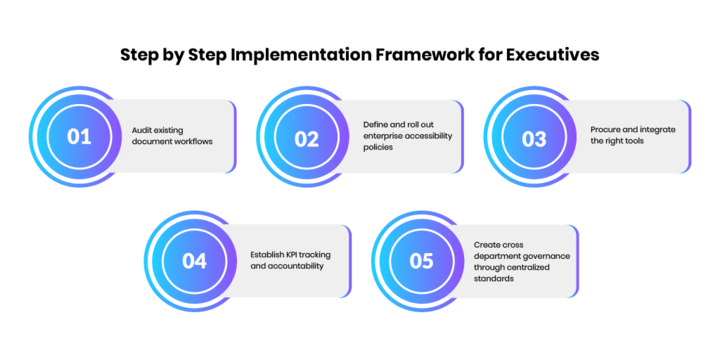
For technology leaders, driving document accessibility at scale requires more than isolated tooling decisions. It demands a structured implementation framework that aligns systems, people, and governance from the outset. The following steps outline a practical approach that can be applied across enterprise environments.
- Audit existing document workflows
Begin by assessing how documents are created, stored, distributed, and archived across the organization. This includes identifying content sources such as enterprise content management systems, reporting tools, and automated output platforms. The goal is to understand where accessibility breaks down and where remediation efforts will have the greatest impact.
- Define and roll out enterprise accessibility policies
Clear standards are essential for consistency. Executives should sponsor organization wide policies that define accessible document requirements, approved formats, authoring guidelines, and remediation responsibilities. These policies should align with broader digital governance frameworks rather than operate as stand alone directives.
- Procure and integrate the right tools
Tool selection should focus on compatibility with existing systems and scalability. This includes accessibility checking tools, automated remediation platforms, and validation solutions that can integrate seamlessly into enterprise workflows. Procurement decisions should prioritize long term maintainability over short term fixes.
- Establish KPI tracking and accountability
Accessibility must be measurable to be sustainable. Key performance indicators may include remediation turnaround time, percentage of compliant documents, and reduction in accessibility related incidents or complaints. Regular reporting helps executives monitor progress and reinforce accountability.
- Create cross department governance through centralized standards
Accessibility efforts often fail when departments operate independently. A centralized governance model ensures that marketing, HR, legal, finance, and operations follow shared standards while retaining flexibility in execution. This structure reduces duplication, improves consistency, and supports enterprise wide adoption.
Collectively, these steps illustrate how tech executives implement accessible document standards enterprise-wide, transforming accessibility from a reactive obligation into a coordinated operational capability.
Measuring ROI and Future Proofing Compliance
For executive leadership, document accessibility must demonstrate business value alongside compliance. As enterprises invest in automation and governance, return on investment becomes a clear measure of program maturity. Cost reduction is often the earliest indicator. Automated remediation and standardized authoring reduce reliance on last minute manual fixes and external interventions. Over time, fewer documents require full rework as accessibility is addressed earlier in the document lifecycle.
Employee efficiency provides an equally important signal. Accessible documents are easier to navigate, search, and reuse, reducing time spent on reformatting and workarounds. For teams managing high volume outputs, this translates into smoother workflows and fewer disruptions across departments. Audit readiness further strengthens the case. Centralized standards, tracked KPIs, and validated remediation workflows allow organizations to demonstrate consistent controls during regulatory reviews, rather than responding reactively to audit findings.
Looking ahead to 2026, enforcement of the European Accessibility Act is expected to intensify, while AI capabilities will continue to evolve toward more personalized content experiences. Enterprises that embed accessibility into document systems now will be better positioned to adapt without rebuilding core processes. Together, these outcomes demonstrate the ROI of AI-driven document accessibility in enterprises through sustained cost control, productivity gains, and long term regulatory confidence.
Conclusion: Accessibility as a Leadership Imperative
Document accessibility is no longer a peripheral compliance concern. It reflects how well enterprise systems are governed and how effectively information is delivered across the organization. For technology executives, driving consistent standards means reducing risk while strengthening operational foundations.
By embedding accessibility into enterprise workflows, leaders move from reactive remediation to sustainable practice. The organizations that succeed will be those that treat accessible documents as a core requirement of digital maturity, not a temporary response to regulation.
Author Bio

Nithish Sugumar is a marketing professional at DocumentA11y the leading pdf and document accessibility services company in the USA. Nithish always thrives on turning strategy into impactful content. Over the past four years in the B2B tech sector, he has designed campaigns that engage audiences, drive conversions, and deliver measurable results. With a focus on content-led growth and full-funnel strategies, Nithish believes the right story can connect people, strengthen brands, and create real business value.