
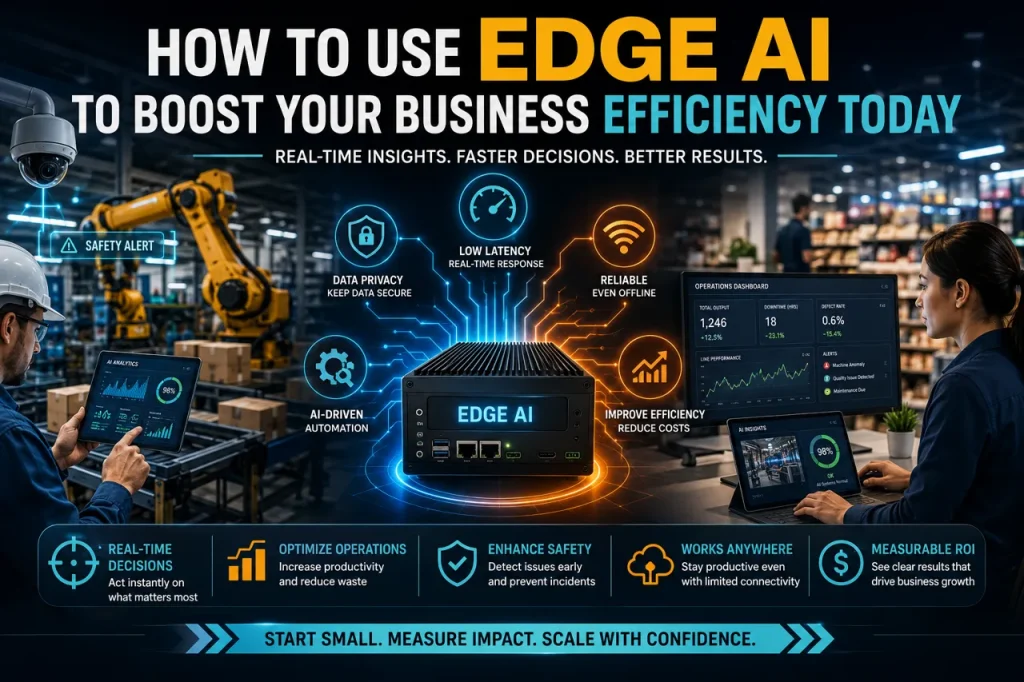
For operations managers and owners at small and medium enterprises, the push to modernize often collides with a hard reality: teams need faster decisions on the front lines, but central systems can’t keep up without adding friction. That’s where edge AI in business matters, because it brings real-time data processing closer to where work happens, turning day-to-day signals into timely actions. The challenge is that AI technology adoption barriers, cost, complexity, and disruption fears, can make even simple upgrades feel out of reach. Done thoughtfully, edge AI supports business operations optimization without a massive rebuild.
Understanding How Edge AI Works on the Front Line
At its core, edge AI means running intelligence right where data is created, not shipping everything back to a central server first. The idea behind edge artificial intelligence is that devices like cameras, sensors, and machines can process data locally, then act on it immediately. Because computing is distributed across many endpoints, decisions happen closer to the work.
That matters because shorter data travel time can cut latency and improve responsiveness in everyday operations. It also enables AI-driven automation during normal workflows, even when connectivity is spotty or bandwidth is limited. The result is faster interventions, fewer delays, and more consistent execution.
Picture a warehouse camera spotting a safety issue and triggering an alert on the spot instead of waiting for cloud analysis. Or a production sensor adjusting settings the moment it detects drift. That is AI algorithms and models working locally to keep processes moving. With that foundation, on-site AI deployment choices become clearer, from hardware to low-latency inference priorities.
Choose an On-Site Edge Server for Reliable, Low-Latency Inference
Once you understand how edge AI delivers decisions closer to where work happens, the next question is what you run those models on. Deploying an edge server on-site puts AI model inference right next to your operations, so you can generate real-time insights without waiting on round trips to the cloud. That local compute reduces dependency on constant connectivity and improves responsiveness when decisions are time-sensitive, especially in environments where downtime or delays have an outsized business cost. In practice, you’re looking for hardware that can host demanding AI models reliably: strong CPU options, GPU capacity for accelerated workloads, and enough storage and expansion headroom to support analytics, virtualization, and growth over time.
For example, the Axial AX300 is a high-performance rackmount edge server built for complex workloads in demanding IT and OT environments. It supports Intel Xeon processors, multiple GPUs, and extensive storage and expansion options, enabling advanced analytics, AI workloads, and virtualization at the edge. Its scalable architecture and built-in security features help you deploy powerful on-premise computing where data is generated, and it’s a scalable industrial rackmount edge server with filtered fan.
Launching Your First Edge AI Pilot, Step by Step
Edge AI is easiest to adopt when you treat it like a measured rollout, not a giant transformation. This process helps you prove value quickly, reduce risk, and set yourself up to scale only after results are clear.
- Pick one high-impact pilot use case
Start with a single workflow where faster decisions clearly reduce cost, waste, or downtime, such as visual quality checks, safety monitoring, or equipment anomaly alerts. Define one success metric you can measure weekly, like fewer defects, faster cycle time, or fewer unplanned stops. Keeping scope tight makes it easier to learn and show wins. - Confirm your data source and “edge-ready” constraints
List what data the model will use, where it comes from, and how often it updates, such as camera feeds, sensor readings, or machine logs. Note constraints that push you toward edge processing, like low latency needs, limited bandwidth, or intermittent connectivity. This step prevents building a solution that looks good in a demo but fails in real conditions. - Validate infrastructure requirements before you buy anything
Estimate what the pilot needs for compute, storage, power, and physical placement, including whether you need acceleration for video or multiple streams. Use market momentum as a sanity check that you are not overbuilding, since the global edge AI processor market is already sizable and offers a wide range of options at different performance levels. The goal is “enough to prove it,” with a clear path to expand. - Integrate with the systems people already use
Choose where insights will land, such as a dashboard, ticketing tool, maintenance system, or simple alerts, and map who needs to see what and when. Start with a lightweight integration, like writing results to a database table or sending notifications, then add deeper automation only after trust builds. This keeps adoption smooth and reduces disruption. - Run a time-boxed test, then scale with evidence
Operate the pilot for a fixed window, like 4 to 8 weeks, and review results against your single success metric plus any unintended side effects. Document what changed, what it cost, and what you would replicate, since the USD 122.8 billion by 2035 growth outlook suggests edge investments will keep accelerating and rewards teams that learn early. If results are positive, expand to the next best use case using the same playbook.
Edge AI FAQs Business Owners Ask Most
Q: What makes edge AI safer for sensitive business data?
A: Edge AI can keep raw video, audio, or sensor data on-site, sending only small results like “pass/fail” or anomaly scores. That reduces exposure compared with streaming everything to the cloud. Start by classifying what data must never leave your network, then design the system to export only aggregated or redacted outputs.
Q: How much does edge AI cost to start, and how do I avoid overspending?
A: Costs usually come from a device to run the model, integration time, and ongoing monitoring. Keep spend down by piloting with one stream of data and reusing existing cameras, sensors, and PCs where possible. Buy for today’s metric, not for every future idea.
Q: Do I need a full data science team to run edge AI?
A: Not necessarily, because many teams begin with pre-trained models and simple rules around alerts. The reality that working on edge AI is still new for most organizations means you can learn iteratively without “perfect” maturity. A practical next step is assigning one technical owner plus one operations owner to review weekly results.
Q: What signals real ROI in edge AI versus a flashy demo?
A: Real ROI shows up as measurable operational change: fewer defects, less downtime, faster throughput, or reduced waste that finance can validate. Since only measure ROI confidently today, insist on a baseline, a single primary KPI, and a time-boxed test window. If the metric does not move, treat that as useful learning and adjust the use case.
Q: When should I choose edge AI instead of cloud AI?
A: Choose edge AI when latency, uptime, or bandwidth makes cloud processing unreliable or too slow. If decisions must happen in milliseconds, or connectivity drops, local inference is usually the safer choice. A good next step is measuring the real-world network conditions in the exact place the model will run.
Start Small With Edge AI to Improve Daily Operations
Edge AI can feel risky when budgets are tight and the ROI can sound like hype, especially with security and skills questions still on the table. The practical path is to focus on edge AI adoption benefits through starting with small-scale deployments that solve one real bottleneck and can be measured. Done well, that creates operational efficiency gains now while laying groundwork for future AI integration strategies and steady business innovation through AI. Edge AI works best when you start small, measure impact, and expand with confidence. Choose one workflow this month and deploy a limited pilot with clear success criteria. That kind of disciplined progress builds resilience and keeps growth in reach, even as conditions change.