
Do you remember what insurance was in the past? You completed a form and responded to some general questions regarding your age, your car, your health history and crunched the numbers based on broad demographic averages.
You were as much as anyone else in your bracket whether you were a careful driver or a reckless one, a fitness enthusiast or someone who hadn’t been to a doctor in 10 years.
While it’s a model that has served for a while, but now it is becoming outdated. The insurance industry is in the midst of one of its biggest revolutions in generations, and IoT is at the heart of it.
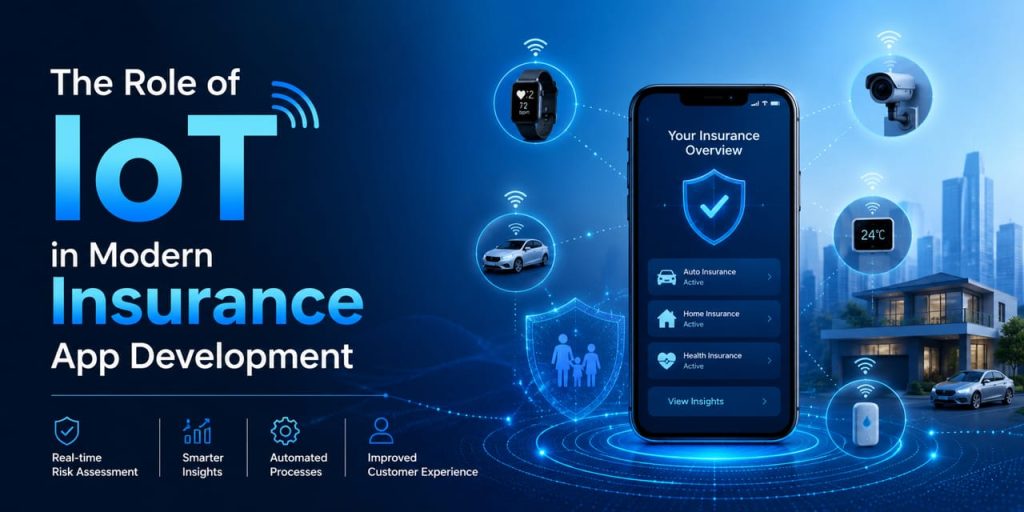
Data is being collected from connected devices, whether it’s the sensor in your car, the wearable on your wrist, or the smart thermostat in your house.
Meanwhile, insurance companies are increasingly developing apps to utilize that data to do what the insurance industry has always wanted to do but hasn’t quite had the capability to accurately price risk on an individual basis in real time.
This blog post will examine how this technology is actually unfolding the use cases, the opportunities and the actual challenges of creating applications for insurance based on IoT.
From Static Profiles to Living Data
The most basic change that IoT introduces to insurance is from fixed risk profiles to moving ones. Historical data and population statistics are used in traditional underwriting. With IoT, that’s turned on its head.
With connected devices, insurers can see what people are doing rather than assuming based on demographics. A telematics device in the vehicle records actual driving behavior, such as speed, braking, nighttime driving time and cell phone usage.
A health wearable includes measuring activity level, sleep quality and heart rate trends over time. A smart home device can determine if a property is being cared for appropriately, if smoke detectors are working, if they’re detecting unusual patterns which may indicate a problem.
The data can be used not only to charge policies more accurately, but also to establish a fundamentally new relationship between the insurer and the insured.
It isn’t just an event that happens once a year during the renewal period; it’s a continuous interaction with actual benefits for both parties.
The Major IoT Use Cases in Insurance Today
So, the usage of IoT in insurance is no longer a dream. There are various use cases that are already well-developed and rapidly expanding.
Usage-Based Auto Insurance
This is likely one of the oldest IoT applications in the insurance sector. Insurers such as progressive’s snapshot and allstate’s drivewise offer programs that modify the premium price based on the way a person drives. The insurer receives more risk information. It’s supposed to be good for both parties.
Smart Home Insurance
From leak detectors to smart locks and security systems to fire sensors, connected home devices can not only help prevent a claim, but also increase the response time should a claim occur.
Certain insurance companies already offer a premium discount for those who install an approved smart device and some are developing apps that link with these devices for real-time alerts and quicker claims processing.
Health and Life Insurance
Wearables are reshaping health insurers’ engagement and risk perspectives. But instead of just check-up data, insurers can now access real-time health data (with the policyholder’s permission) to incentivize healthy habits, alert them to potential health issues at an early stage, and create wellness programs that have an impact.
Commercial and Industrial Insurance
From the commercial perspective, IoT is changing the way companies are covering their assets and processes. Data from fleet management sensors, equipment health monitors, warehouse environment control systems and supply chain trackers can all help to provide more accurate cover and quicker claims handling.
This type of sensor-driven insight can be truly revolutionary for businesses that rely on costly machinery or have valuable inventory.
What Does IoT Means for App Development?
Creating an insurance app that takes data from IoT is a completely new consideration from creating a standard insurance platform. The technical difficulty increases greatly and so do the stakes.
A few things that become critical when IoT is in the mix:
- Continuous data streams from thousands or millions of devices at once, real-time data ingestion and processing pipelines.
- Device integration layers that will communicate with a broad number of hardware manufacturers and protocols.
- A strong data storage solution with reasonable cost and sufficient data for underwriting, claims and regulatory compliance.
- Models for analytics and machine learning that can be used to extract meaningful risk signals from raw sensor data.
- Security measures to safeguard sensitive personal information throughout the pipeline.
This is as important on the user side. Policyholders must be aware of the data that’s being gathered, how it’s being used and what they are getting in exchange. Apps that cover this up create a lack of trust and churn. Those that transparently present it and teach users how their behavior is impacting their rates or coverage are the ones that tend to foster engagement.
The Privacy and Ethics Questions You Can’t Ignore
IoT in insurance raises some pretty tough questions about privacy, consent and fairness.
If an insurer can be provided with ongoing behavioral information on a policyholder, the situation changes a lot. Most likely, the majority of users who enroll in a telematics program or download a wellness app don’t read the conditions associated with the use of their data, retention or what will happen if they change vendors.
There is a huge accountability of the insurers and the developers to ensure such disclosures are effective, rather than merely legally binding.
What about the issue of discrimination based on the data collected from IoT devices that may seem unfair to some people and perpetuate current inequities? A telematics system may penalize a driver who has a night job for driving at night, even though they are actually working.
A person who is in a neighborhood where the risk for the environment is greater may pay more for a smart home premium, thus making their home ineligible for coverage.
Regulators are starting to take a renewed look at IoT data and its application in underwriting. In Europe, GDPR compliance is a requirement, in California, CCPA compliance is a requirement, and now, a variety of state-level insurance regulations in the US are also requirements and they can’t be added on after the app is launched.
Choosing the Right Development Partner
As much as the complexity of the work, the selection of the development partner is extremely significant while creating an IoT integrated insurance application. You’re not only hiring for the ability to write clean code, you’re hiring for a team that grasps the nuances of connected device infrastructure, insurance domain logic, data privacy regulations, and end-user user experience.
An experienced IoT app development company has more to offer than technical expertise. They’ve already addressed many of the integration challenges you’ll face, know what it takes to create scalable data pipelines for device fleets, and understand how to design systems that will grow and adapt to changes in technology and regulation.
Likewise, when considering the insurance app development services, search for the ones who have experience in the insurance sector. There’s so much about insurance logic, how policies are structured, how claims are processed, how reinsurance works, regulatory reporting requirements, etc. A team that has experience in this field will save you countless hours and headaches by having them already.
The perfect match for such a project lies in between both worlds that are robust IoT engineering capability and insurance industry expertise. This is less of a combination of the two than either one alone, but this is the requirement for the complexity of IoT driven insurance apps.
Where This Is All Heading?
The direction here is pretty straight-forward. The more pervasive IoT devices are, and the more complex the information they provide, the more personalized, pro-active and life-encompassing insurance will become.
There are early examples of what may be termed “continuous underwriting” that is, policies which can change in real time rather than on a set annual schedule, according to the latest available information. Parametric types of insurance that trigger a payout based on a sensor-measured event that falls within a specific range of parameters are expanding, such as in crop insurance and natural disaster coverage. The ability to act as a predictive risk prevention to warn users about potential issues before they turn into claims is now a differentiator expectation.
The insurers and developers who find a way to get this right who create applications that are actually useful to policyholders, rather than just an annoyance to them, and who are responsible with the data and strict in the compliance requirements are going to be in a good position to capitalize on this market as it continues to expand.
Closing Thoughts
IoT is not just shifting the edges of insurance app development services, it’s altering the rules of the game of insurance risk evaluation, pricing and management.
This change from demographic to actual behavioral data is very meaningful and the insurance apps being developed now are just the beginning of what this technology can achieve.
If you are a business that wants to move into this area, it can certainly be done and it is a good time to be doing it. But execution complexity is a reality, too.
The technical architecture can be so complex, user data treated like just another number, the regulatory environment so daunting, and the user experience so unwelcome, that all the thoughtful development work has to be done by people who know technology as well as the industry they are applying it to.
Those who invest in getting it right will have a sustainable competitive edge. Those that view it as a checkbox exercise are in for a shock as they discover IoT-driven insurance isn’t as straightforward as it seems from the outside.
However, we can tell you that if you have not adopted IoT in your insurance business, it is high time to do so.