
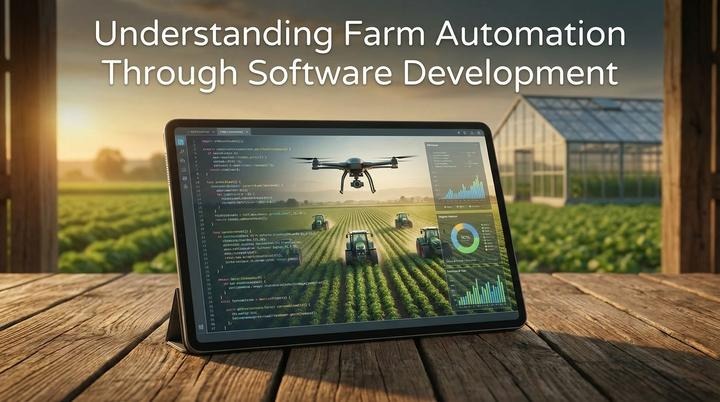
From early crops to today’s large commercial farms, agriculture has always been essential. Modern farmers face many challenges that our ancestors never had. Costs are rising, finding labor is harder, and extreme weather events are happening more often.
To keep farms productive, farmers are turning to technology. Automated farming is becoming a necessary tool. It combines machines, sensors, and software to make farming faster and more efficient. Automation helps farms get more work done with less effort. It also helps farmers meet the growing demand for food around the world.
Software plays a key role in this agricultural transformation. It connects machines, sensors, and other tools. It collects data, gives guidance, and controls machines in real time. With the right software, farms can operate more smoothly, save money, and respond quickly to problems.
What Is Farm Automation?
Farm automation, also called smart farming or precision agriculture, uses technology to reduce manual work and improve efficiency. It combines machines, digital tools, and sensors to do tasks that humans once did by hand. Automated systems can plant seeds, water crops, monitor growth, and harvest produce with minimal human help.
This technology does not replace humans completely. It changes the type of work they do. Farmers spend less time on repetitive tasks and more time making decisions and managing the farm. Automation makes farms more productive without needing more labor.
How Software Helps Modern Farms
Software is the backbone of farm automation. It collects information from sensors, drones, and machines and turns it into useful insights. Farmers can track soil health, check crop growth, optimize watering, and spot problems early.
Software can also control machines directly. Tractors, robotic harvesters, and seeders use software to work accurately. Alerts from the software notify farmers if there is a problem, such as a pest outbreak or lack of water. This lets farmers act quickly to prevent losses.
Farm management platforms bring all tools together. Farmers can see their farm’s performance in one place. They can track finances, inventory, labor, and field conditions. They can also plan planting and harvesting using real information. This helps farms run more smoothly and reduces mistakes.
Technologies Used in Farm Automation
Farm automation uses a mix of tools to make farming easier. Sensors and IoT devices measure soil moisture, temperature, and nutrients. They give real-time updates. For instance, if a sensor detects dry soil, an irrigation system can water only the areas that need it. This saves water and helps crops grow better.
Drones provide a bird’s-eye view of the fields. They can detect pest problems, disease, or irrigation issues quickly. Tasks that once took hours now take minutes.
Machines handle the heavy work. Tractors can plant seeds and spray crops automatically. Robotic harvesters can pick produce carefully without damage. Robotic weeders remove unwanted plants and reduce the need for chemicals. These machines cut labor costs and increase crop consistency.
Farm management software connects everything. Platforms such as Granular, FarmLogs, AgriWebb, Cropwise, and Climate FieldView give farmers a complete view of their operations. They provide real-time information and allow farmers to plan and manage efficiently.
Benefits of Farm Automation
Farm automation is more than just new machines. It changes the way farms operate and brings many advantages. Agriculture software development services play a key role in this process by creating systems that monitor, manage, and optimize farm operations efficiently.
First, it increases efficiency. Machines can work around the clock. Crops are harvested at the right time. This reduces waste and improves output.
Second, farms can earn more money. Systems that monitor soil and crops help farmers make the most of their land. They save on labor costs and increase yield. Some farms in California have seen profits rise by 15 percent after adopting automation.
Third, automation reduces dependency on human labor. Farm work is hard, and fewer people want these jobs. Automation lets farms keep working even with fewer workers. Robots handle planting, harvesting, and monitoring while farmers focus on important and informed decision-making for their agricultural businesses.
Fourth, it improves crop quality. Sensors and analytics ensure plants get exactly what they need. Crops are harvested carefully and consistently. This produces better products and happier customers.
Last but not least, automation helps farmers make decisions based on facts. Farmers can track weather, soil, and market trends. They can decide when to plant, irrigate, or harvest. Early alerts about pests or bad weather help prevent losses.
Challenges of Farm Automation
Farm automation is not easy to implement. Machines and software cost a lot. Upgrading to automated harvesters, tractors, and drones requires big investments.
Operating these tools can be complex. Many farmers are used to traditional methods. Learning new technology can take time.
Weather can also affect machines, and storms, heat, or frost may disrupt automated systems. In addition, connectivity is a challenge because many automated tools need the internet to work properly. If connections are slow or unreliable, the system may fail.
Some workers worry about losing jobs. However, automation reduces the need for manual labor while also creating new roles. For example, workers can focus on managing systems, analyzing data, and improving farm efficiency.
Key Takeaway
Farm automation is changing the agricultural landscape at large. It combines smart agricultural machines with software to make farms more productive, efficient, and profitable. However, challenges such as high costs, technical complexity, and weather risks are obstacles. But the benefits clearly outweigh these issues. Farm automation allows farms to produce more food with limited resources. For modern agriculture, understanding and using farm automation through software is crucial. It makes farms more productive, sustainable, and ready for the future.