
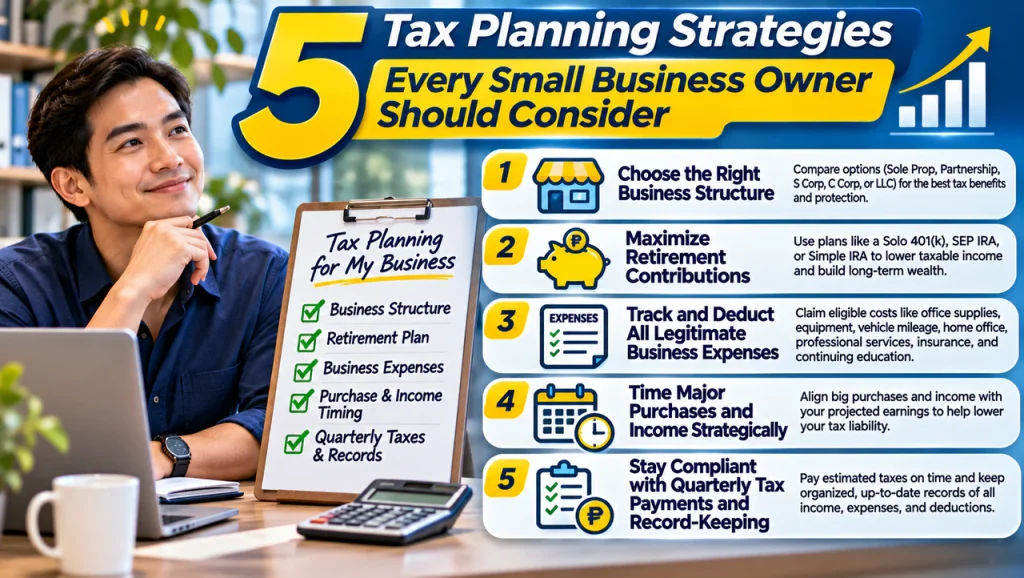
What if you could reduce your tax burden simply by planning a few months ahead? Most small business owners focus on growing revenue but overlook the strategic decisions that can significantly lower their tax liability. Tax planning is not just about filing forms at year-end; it is about making intentional choices throughout the year that align with your business structure, income patterns, and long-term goals. The following five strategies can help you keep more of what you earn.
1. Choose the Right Business Structure
The way you structure your business has major tax implications that affect everything from self-employment taxes to liability protection. Small business owners typically choose between operating as a sole proprietor, partnership, S corporation, C corporation, or LLC, and each structure carries different tax consequences. For example, a sole proprietor reports all business income on their personal tax return and pays both the employer and employee portions of self-employment taxes, which can amount to roughly 15 percent of net earnings. An S corporation, by contrast, allows you to pay yourself a reasonable salary and take additional distributions as dividends, potentially reducing your self-employment tax burden, though it requires more administrative work and filing requirements. Before starting or restructuring your business, consult with a tax professional to compare how each structure would affect your specific circumstances, and revisit the decision annually as your revenue grows.
2. Maximize Retirement Contributions
Retirement contributions represent one of the most powerful tax-reduction tools available to small business owners because they reduce your taxable income while helping you build long-term wealth. Options like Solo 401(k)s, SEP IRAs, and Simple IRAs allow you to contribute substantially more than a regular IRA, and those contributions are tax-deductible. A Solo 401(k) is particularly valuable if you are the only employee of your business, since you can contribute as both employer and employee, potentially sheltering tens of thousands of dollars from taxation in a single year. A SEP IRA is simpler to administer and allows contributions of up to 25 percent of your net self-employment income, while a Simple IRA may suit businesses with employees that prefer less paperwork than a traditional 401(k) requires. The key is to choose a plan that fits your business size and complexity, then maximize contributions consistently, since many owners leave money on the table simply by not taking full advantage of available contribution limits.
3. Track and Deduct All Legitimate Business Expenses
Every dollar you can legitimately deduct as a business expense reduces your taxable income, yet many small business owners fail to claim expenses they are entitled to. Common deductions include office supplies, equipment, vehicle mileage, home office space, professional services, insurance, and continuing education. If you use one room of your home exclusively for your business, you can deduct a portion of your rent or mortgage, utilities, and maintenance costs based on the square footage of that room. For vehicle use, you can deduct either actual expenses or the standard mileage rate, which the IRS updates annually, and professional development costs such as courses, conferences, and certifications directly related to your business are also deductible. Consider using accounting software or working with a bookkeeper to ensure no deductions are missed and that documentation remains complete throughout the year rather than assembled under pressure at tax time.
4. Time Major Purchases and Income Strategically
When you make large purchases and when you recognize income can affect your tax bracket and overall liability in a given year. If you anticipate an unusually profitable year, you might accelerate certain equipment purchases or business improvements before year-end to increase deductions and reduce taxable income for that period. Conversely, if business has been slow, deferring purchases until the following year when you expect higher income can maximize their deduction value. Timing the payment of business expenses and managing when you collect income from clients can also influence which tax year expenses and revenue are reported. Business owners who work with financial advisor Scottsdale professionals rely on can project income and expense timelines with greater precision, ensuring that strategic deferral decisions are grounded in accurate forecasts rather than guesswork. This strategy works best when combined with a clear understanding of your projected income and expenses for the next 12 to 18 months.
5. Stay Compliant with Quarterly Tax Payments and Record-Keeping
Small business owners often owe estimated quarterly taxes, and failing to make these payments can result in penalties and interest charges that compound your tax burden. The IRS expects self-employed individuals and certain business owners to pay estimated taxes four times per year based on projected income and tax liability, and missing a deadline can trigger penalties even if you ultimately owe nothing when you file your return. Beyond payments, keeping organized records of all income, expenses, and deductions in real time makes tax preparation smoother and gives you confidence in every figure you report. Consider establishing a simple system where receipts and invoices are captured weekly or monthly rather than accumulated over the entire year. Digital tools and cloud-based accounting software make this easier than ever, and the small effort invested in good record-keeping can save significant time and stress when tax season arrives.
Conclusion
Tax planning is an ongoing process, not a once-a-year task that happens in April. By implementing these five strategies, you position your small business to minimize taxes while maintaining compliance and supporting long-term growth. The most effective approach combines choosing an appropriate business structure, maximizing retirement contributions, tracking every legitimate deduction, timing major decisions strategically, and staying current with payments and records. Each business is unique, and what works best for one owner may differ based on income level, business type, and personal circumstances. Taking time to develop a tax plan now, ideally with guidance from a qualified tax professional, can translate into significant savings over time and greater financial security for your business.