
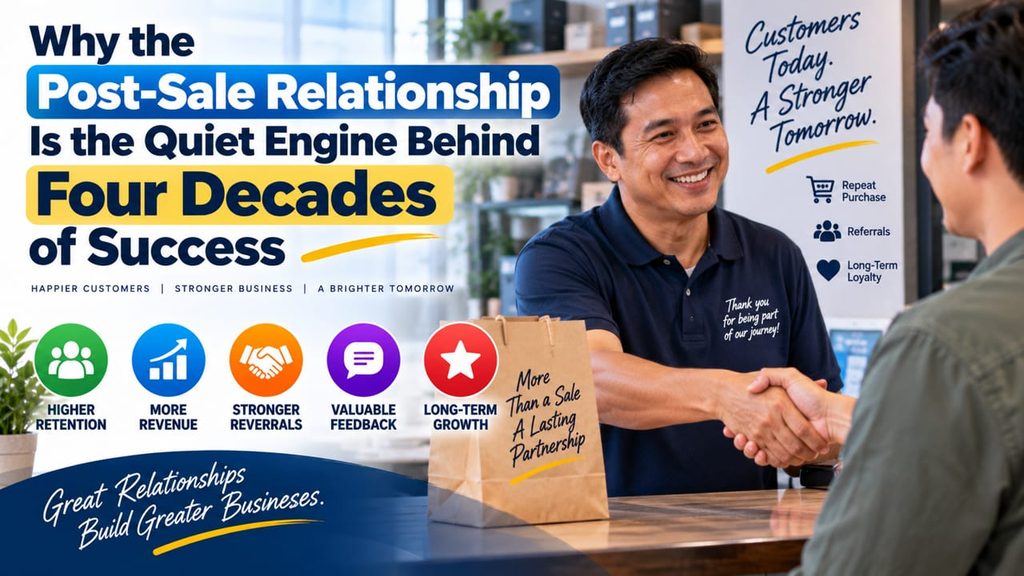
Most businesses pour energy into the run-up to the sale, but durable value lives in what happens after money changes hands. Loyal customers tend to buy more products, stay longer, and act as an advocate for your brand. In fact, acquiring a new customer runs roughly five times the cost of keeping an existing one. In this article, we discuss how investing in the post-sale relationship has played a pivotal role in our brand’s long-term success.
What Post-Sale Investment Actually Returns
Retention Compounds in a Way Acquisition Never Will
Customer retention should be treated as a compounding asset rather than as a cost center. Positive post-sale experience makes continued purchasing far more likely, and an increase in retention will generally lift your brand’s profits. Churn also tends to be costly, especially at scale. In contrast, each retained customer’s value multiplies over time and pulls other potential customers in behind them. That compounding effect is something worth investing in.
Loyal Customers Spend More, and More Often
Loyal customers are more likely to add on to their initial order (upselling) and also buy adjacent products and services (cross-selling) from your brand. This makes sense since new customers will likely trust you less and resist expansion while established ones do have a reason to stay. Brand familiarity also shortens each customer’s decision time while widening the basket.
Repeat customers spend more than first-time buyers, and existing customers are more likely to try new products than new customers. There is thus an increasing purchase probability as the number of purchasers increases. The general takeaway here is that cared-for customers come to see vendors as trusted partners, which improves both upselling and cross-selling.
Lifetime Value Is Where the Relationship Pays Off
Customer lifetime value refers to the total revenue that a customer brings across their entire relationship with a brand. Post-sale support extends the relationship, raises purchase frequency, and lifts average transaction value while reducing price sensitivity. As a result, an increase in brand loyalty will raise CLV per customer. High-value customers often do so by feeding the referral loop, creating more customer relationships to nurture.
Satisfied Customers Market for You
Word-of-mouth marketing is the natural byproduct of investing in post-sale relationships. Happy customers will recommend you to friends, family, and colleagues at no cost, and those recommendations tend to convert better than paid channels. This is likely because they know who they are engaging with well enough to make targeted, meaningful suggestions.
However, customer recommendation cannot be forced; it follows from genuine satisfaction. When your customers are satisfied, they become automatic marketers for your brand. Light referral incentives will boost this process and turn happy customers into a self-sustaining network of advocates.
How We Build Relationships That Last
Ask for Feedback, Then Act on It
The first major step to building a post-sale relationship is to ask for customer feedback and then take genuine action. Start with a personal check-in within 72 hours of purchase and then follow up at set intervals (e.g., 30 days, 90 days) to create recurring openings for customers to share their opinions.
Real conversations or short personalized emails outperform generic form surveys for building an actual relationship. Acknowledge feedback and visibly act on it, since customers who see their input taken seriously will become invested in your success. Better feedback is itself another competitive advantage, surfacing problems early and pointing toward new product opportunities.
Earn Referrals, Don’t Just Request Them
Encouraging referrals also helps build an entire post-sale network. Demonstrate value first and then ask for referrals at certain high points, such as after a strong check-in or once you’ve acted on their feedback. There could even be an incentive in place where a customer gets to preview a new, exciting product if they can refer a customer that successfully converts. Personally thanking customers who refer your brand is another way to build that post-sale relationship even if the person they refer does not convert.
Personalize Every Interaction
You can also build better and deeper relationships with your customers by personalizing every interaction. This is a key and underappreciated fundamental of great customer service. Track preferences, remember past conversations, record details specific to your business, and then reference them with repeat customers so that they feel valued. Train your staff to carry these habits everywhere so that the whole business makes customers feel seen.
Build a Knowledge Base
Knowledge bases help customers get full value from their purchase, which then gives them another reason to be loyal to your brand. The form of your knowledge base depends on what you sell and what customers need to know, but the objective stays the same: fully equipped customers are more satisfied and more loyal.
Self-service also reduces strain on support staff, freeing them for higher-value personal service. AI chatbots and other similar forms of automation can easily extend a knowledge base for fast, human-free resolution of common issues.
Reward Loyalty Deliberately
Loyalty programs reward exactly the customer behavior you want. For example, a machining manufacturer could encourage repeat purchases, referrals, and engagement if they rewarded a particularly loyal customer with a discount on the newest range of CNC routers. Just as with knowledge bases, the shape of your ideal reward scheme will depend on your business and target audience.
Value-driven loyalty programs tend to increase CLV and drive members to spend more, while a poorly designed program frustrates customers and increases churn. Collect customer feedback on what customers want and design the reward system accordingly.
Key Takeaways
Chasing conversion rates is tempting, but investing in the post-sale relationship is the smarter long-term financial move. Building loyal customers leads to stronger retention, more upselling and cross-selling, higher lifetime value, free word-of-mouth, sharper feedback, and richer customer knowledge.
Owners can invest in post-sale relationships by soliciting and acting on feedback, earning referrals, personalizing their customer service model, building a knowledge base, and running a well-designed loyalty program. Businesses built to last decades keep customers feeling valued long after the first sale closes.
Author Bio:

Jess Muehlfeld is the Marketing Supervisor at Laguna Tools, bringing a performance focused, content first approach to the woodworking, furniture, cabinet, sign, CNC routing, and metalworking spaces. She works closely with CNC experts, operators, technicians, and makers to help translate shop feedback into clear, practical content that supports real workflows. From hobby projects to high output manufacturing, Jess focuses on building trust and driving qualified demand, guided by a simple idea: built for makers, built for production.