
As the secondary market for all vehicle parts, repairs and accessories after initial car sales, the global automotive aftermarket industry is a massive economic engine that consistently demonstrates remarkable innovation and resilience. Spanning everything from replacement components to aesthetic accessories and high-performance upgrades, it represents a rapidly expanding ecosystem that keeps millions of vehicles functional worldwide.
For entrepreneurs and business leaders, the automotive aftermarket industry offers a masterclass in adaptability, supply chain agility and customer loyalty. This niche sector for car enthusiasts actually offers a goldmine of business lessons for the savvy, forward-thinking founder. By observing how automotive aftermarket brands operate and scale, entrepreneurs can extract highly actionable lessons to accelerate their own business growth. So, let’s get analyzing to find a strategic blueprint that can help you in your business.
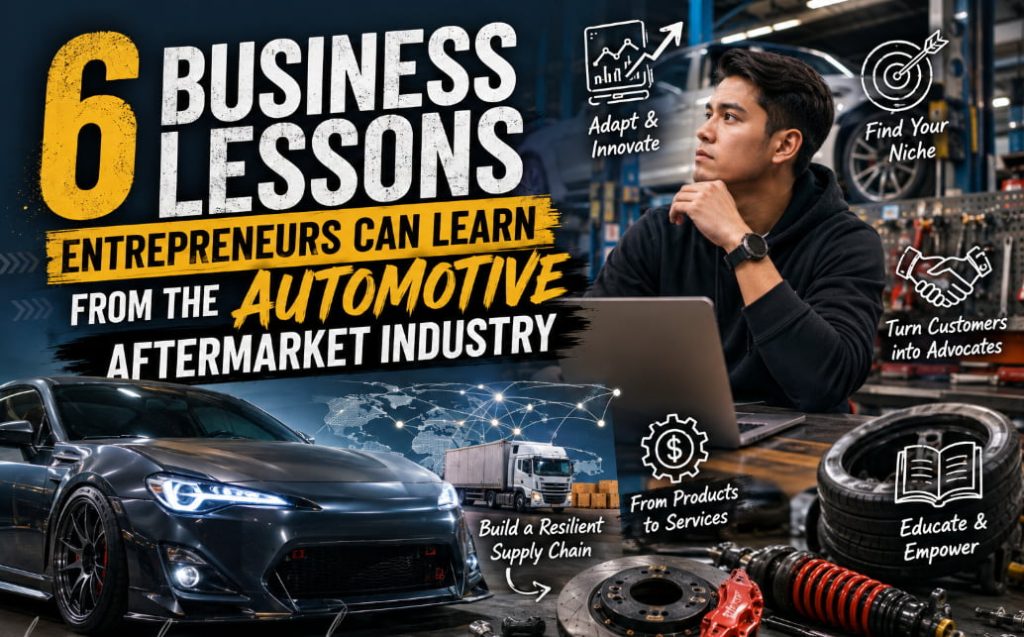
1. Find a Hyper-Targeted Niche Market
One of the most profound lessons the automotive aftermarket industry offers is the importance and profitability of hyper-specialization. Some of the most successful businesses don’t attempt to sell to every consumer; instead, they cater to highly distinct buyer personas with specific needs, budgets and brand loyalties.
For instance, a driver modifying a Japanese sports car will seek out specialized vendors for high-quality aftermarket auto body parts to ensure precise fitment and specific aerodynamic performance, rather than shopping at a generic store.
Niching down creates a distinct competitive advantage, allowing you to offer something highly sought-after to a specific customer segment, while simultaneously building brand credibility. By dominating a narrow vertical first, businesses can establish a reliable revenue foundation and create customer loyalty, before attempting to expand into broader, more saturated markets (if that’s on the agenda).
2. Be Adaptable During Technological Advancement and Disruption
Electrification, advanced driver-assistance systems and software-defined vehicles are currently totally transforming the automotive industry. The automotive aftermarket industry has had to rapidly evolve alongside these innovations, transitioning from a focus on purely mechanical fixes to integrating complex digital diagnostics and updates. The increasing prominence of automotive software development companies highlights how crucial tech integration has become to vehicle maintenance and enhancement.
Adaptability is important in all businesses, as technological advancements and disruption are inevitable in any sector. Rather than resisting new technologies or clinging to legacy business models, successful founders pivot their offering to incorporate new innovations. Upskilling your workforce, investing in updating your product catalog, and finding continual ways to innovate as technology changes will all ensure your brand remains relevant and indispensable.

3. Build a Resilient, Data-Driven Supply Chain
Managing inventory in the automotive aftermarket industry is notoriously complex, often requiring companies to handle thousands of individual units across multiple vehicle makes, models and production years.
While, historically, many industries relied on ‘just-in-time’ supply chains to minimize warehousing costs, recent global disruptions have exposed the extreme vulnerability of this model. So, today, leading aftermarket distributors are investing heavily in AI-driven demand forecasting and localized supply networks to ensure parts are available exactly when customers need them.
Entrepreneurs should view supply chain management as both an operational necessity and a core competitive advantage. If your business sells physical products, utilizing predictive analytics to balance inventory levels can prevent the dual pitfalls of costly overstock and frustrating stockouts. This can hugely benefit customer retention, as customers know they can rely on you to provide what they need when they need it.
4. Transition From Products to ‘Servitization’
While selling standalone products can be highly profitable, it’s generally a one-time transaction. Selling an ongoing service, however, creates predictable, recurring revenue. The modern automotive aftermarket industry excels at a concept known as ‘servitization’, which involves selling services alongside physical products to add extra value and create extra income. For example, industry leaders now offer services like professional installation networks, predictive maintenance alerts and extended warranties.
This is a critical lesson for startups and established enterprises alike. Founders should constantly evaluate how they can wrap profitable services around their core physical products. Whether it’s offering a subscription model for ongoing support, providing comprehensive training resources, or building an ecosystem of complementary accessories, servitization deepens the customer relationship and maximizes the lifetime value of every buyer.
5. Turn Customers into Passionate Brand Advocates
In any industry, establishing a scalable route-to-market requires mastering the ‘4 A’s’ of marketing: Availability, Affordability, Awareness and Advocacy. While the first three generate initial sales, it’s the advocacy that truly sustains long-term growth.
Like many audiences and customer segments, automotive enthusiasts are highly community-driven, relying heavily on word-of-mouth recommendations, dedicated online forums and social media posts to validate their purchasing decisions. Brands that succeed do so by actively participating in these communities.
Turning customers into true brand advocates is one of the most underestimated and powerful marketing strategies you can implement; your existing, satisfied customers are your most effective marketers. Businesses can focus on building this by offering exceptional customer support, creating loyalty programs, encouraging user-generated content, and investing in influencer marketing. When your customers feel a sense of ownership and personal connection to your brand, they’ll organically promote your products, driving sustainable, limitless growth.

6. Empowering Customers Through Educational Content
Another key driver of success in the automotive aftermarket industry is the heavy emphasis on consumer education. Many leading aftermarket brands don’t just sell products; they provide comprehensive DIY installation videos, detailed troubleshooting guides and technical schematics. By removing any intimidation associated with vehicle modifications, these companies allow customers who aren’t auto aficionados to buy from them and get involved in their own car maintenance, potentially creating a future returning customer.
Educational content marketing where you’re proactively teaching your audience how to successfully use your product to solve a real problem builds instant trust. Providing robust, accessible resources reduces customer service inquiries too, and transforms hesitant shoppers into confident consumers. It’s a win-win!