
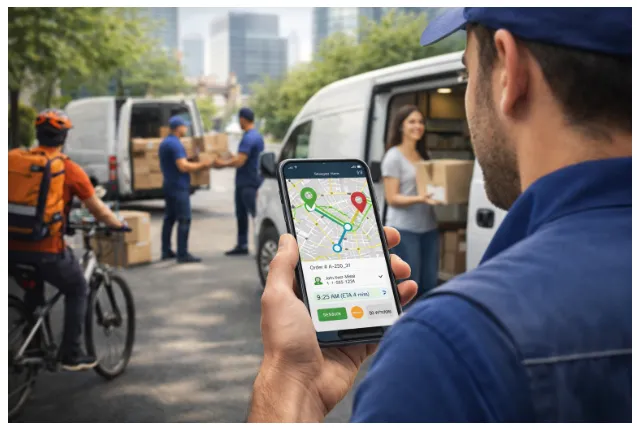
Starting a delivery service is one of the most exciting moves a business can make. Demand is high, customers love convenience, and the opportunity for growth is real. But behind every failed delivery startup, or every business that lost money in its first year of offering deliveries, is a list of avoidable mistakes that nobody warned them about.
Whether you are planning to deliver food, groceries, medicine, or even fuel to your customers’ doorstep, the challenges are surprisingly similar. In this article, we break down the most common mistakes businesses make when starting delivery services, and more importantly, how you can avoid them from day one.
Mistake 1
Relying on Manual Processes Instead of Technology
Many businesses start their delivery operations using WhatsApp messages, handwritten logs, phone calls, and spreadsheets. While this may work for a handful of orders per day, it quickly becomes a nightmare as demand grows. Orders get missed, drivers take wrong routes, and customers are left waiting without updates.
The smarter move is to invest in a proper delivery management system early, even before you scale. A dedicated app or platform allows you to take orders, assign drivers, track deliveries in real time, and notify customers automatically. This is especially critical in specialized delivery sectors. For example, businesses offering on-demand fuel delivery cannot afford manual coordination errors; a fuel delivery app streamlines the entire process from order placement to driver dispatch and payment, eliminating costly human errors and giving customers a seamless experience from start to finish.
Mistake 2
Underestimating Delivery Costs
A surprisingly common mistake is launching a delivery service without fully calculating what each delivery actually costs. Business owners often think about driver wages and fuel, but forget to factor in vehicle maintenance, insurance, packaging, failed deliveries, and customer support overhead.
Before you launch, map out your cost per delivery down to the last peso. Then price your delivery fee, or build it into your product pricing, in a way that keeps your margins healthy. Offering free delivery without understanding your break-even point is one of the fastest ways to bleed money quietly.
Tip: Calculate your true cost per delivery by adding: driver pay + fuel + vehicle wear + packaging + failed delivery rate + support cost. Only then set your delivery pricing.
Mistake 3
Ignoring the Customer Experience
Many businesses focus entirely on the logistics side, getting the product from point A to point B, and forget that the customer experience is what drives repeat orders and word-of-mouth growth. Customers today expect real-time tracking, accurate ETAs, and instant notifications. If they cannot see where their order is, they will call your support line, get frustrated, or simply never order again.
Invest in features that keep customers informed at every step. Automated SMS or app notifications when the order is confirmed, when the driver is on the way, and when the delivery is complete go a long way in building trust. Even a simple “Your order is 10 minutes away” message can turn a one-time buyer into a loyal customer.
Mistake 4
Hiring Without a Clear Driver Management System
Your delivery drivers are the face of your business. Yet many startups hire drivers without proper onboarding, without clear performance metrics, and without any system to track accountability. This leads to late deliveries, poor customer interactions, and drivers taking inefficient routes that inflate your fuel costs.
Build a driver management process early. This includes background checks, clear delivery protocols, a rating system so you know who your best performers are, and a way for customers to provide feedback on each delivery. Technology plays a huge role here; a good delivery platform will show you driver performance data so you can reward top performers and coach those who need improvement.
Mistake 5
Launching Without Testing Your Operations
Excitement about launching often causes businesses to skip a critical step: testing. Before going live with a full customer base, run internal test orders. Simulate real delivery scenarios. See how long each delivery actually takes. Identify where your system breaks down, whether that is the ordering flow, the payment process, or the handoff between dispatcher and driver.
A soft launch with a small group of customers is far better than a big launch that falls apart publicly. Use that early feedback to fix issues before they become your reputation.
Mistake 6
Not Having a Scalable Tech Foundation
Some businesses build their delivery operations on tools that work for today but cannot handle tomorrow. A basic booking form or a borrowed app might be fine for 20 orders a day, but what happens when you hit 200? Systems crash, data gets lost, and the customer experience suffers at exactly the moment your business should be celebrating its growth.
From the very beginning, think about scalability. Whether you are delivering groceries, pharmaceuticals, or fuel, your technology backbone should be able to grow with you. A purpose-built on-demand delivery app solution, built by experienced developers, ensures your platform can handle growing order volumes, multiple drivers, multiple zones, and future features, without needing a complete rebuild every time your business expands.
Think Long-Term:- The technology you choose at the start will shape how fast you can grow. A scalable platform is not an expense; it is the foundation of your competitive advantage.
Mistake 7
Poor Route Planning and Time Management
Inefficient routing is one of the highest hidden costs in delivery operations. Drivers taking longer routes, making deliveries in the wrong order, or getting stuck in avoidable traffic all eat into your margins and frustrate customers with late arrivals.
Invest in route optimization from the start. Modern delivery platforms come with built-in route planning that automatically assigns the most efficient path for each driver based on current traffic, delivery locations, and priority orders. This alone can reduce fuel costs by 15 to 30 percent and significantly improve your on-time delivery rate.
Mistake 8
Neglecting Legal and Safety Requirements
Different types of delivery services come with different regulatory requirements. Fuel delivery, for example, involves strict safety and compliance standards around the handling, transport, and storage of flammable materials. Food delivery requires hygiene standards. Medicine delivery may require pharmacy licensing.
Skipping the legal groundwork might save time in the short term, but it can result in heavy fines, forced shutdowns, or liability issues down the road. Research the requirements for your specific type of delivery service in your area and get compliant before you launch, not after.
Final Thoughts
Starting a delivery service is a real opportunity, but it rewards those who plan carefully and use the right tools. The businesses that succeed are not always the ones with the biggest budgets. They are the ones that avoid these common mistakes, invest in the right technology early, and obsess over the customer experience from day one.
If you are serious about building a delivery business that lasts, start by getting your operations, technology, and team in order. The delivery market rewards efficiency, reliability, and speed, and the businesses that master those three things are the ones customers keep coming back to.
About the Author Bio:

Name: Anil Patel
Create our account with
Email: [email protected] (Connected with Gravatar)
USER ID: anilhpatel
Website: https://nectarbits.com
LinkedIn: https://www.linkedin.com/in/ani2nil/
As a Digital Marketing and Content Strategist Planner at NectarBits, A Leading Software Development Company in the USA and a SaaS small business Solution in Canada, I am effectively behind the company’s content strategy, copywriting, brand communication, and operations. My prime focus is Content Marketing and ROI. I love writing and sharing knowledge. On weekends, I enjoy watching Tom and Jerry cartoons on TV.