
By Janson Wang
Finding a supplier is easy. Verifying that the supplier can repeatedly deliver the exact product, quality, packaging, and timing your store needs is much harder.
This distinction matters when an ecommerce business starts to scale. A sample can look good while production remains inconsistent. A low quotation can hide unstable lead times, missing components, weak packaging, or unclear responsibility when something goes wrong. Small teams often discover these gaps only after advertising spend and customer orders have already increased.
Supplier verification should therefore be treated as a controlled operating workflow, not a one-time background check. The goal is not to prove that a supplier will never fail. The goal is to collect enough evidence to decide whether to test, proceed, limit volume, or stop before customers absorb the risk.
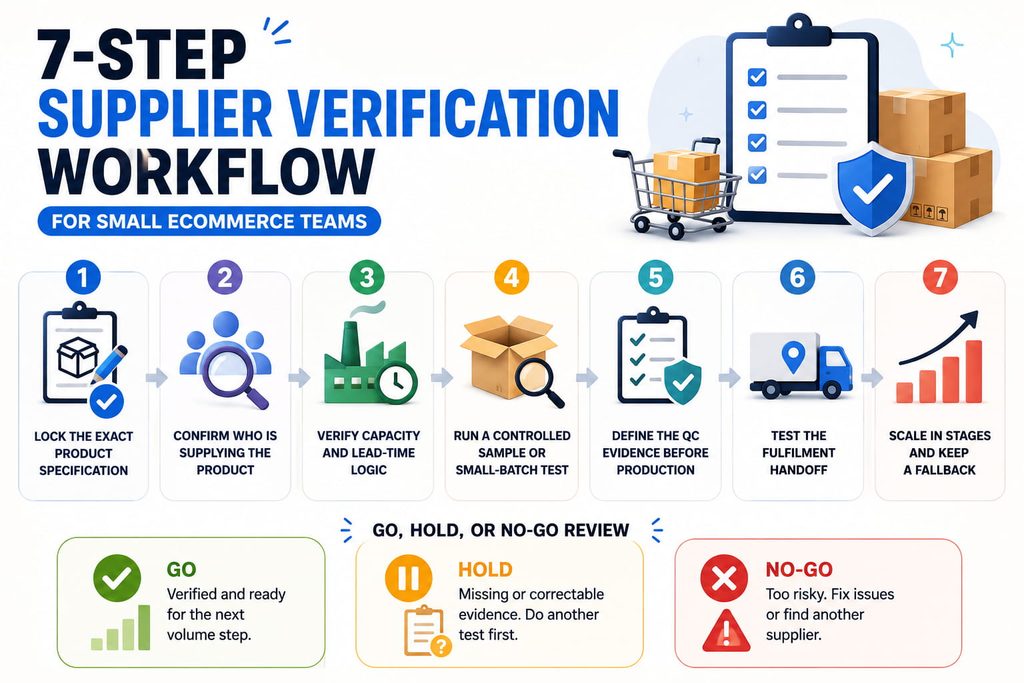
1. Lock the Exact Product Specification
Start by defining the product you are actually buying. A product link or a sample photo is not a complete specification.
Record the exact model, material, dimensions, colour, variant, included accessories, labelling, barcode, packaging, and any functional requirements. If the item has several versions, identify which version was quoted and which version was sampled. For customised products, separate the base product specification from the custom logo, insert, label, or packaging requirements.
This first record becomes the reference for every later check. Without it, a supplier can deliver something that is technically similar but commercially wrong. It also becomes difficult to decide whether a defect is a production failure, a misunderstanding, or a change that was never approved.
Decision point: Do not move to a larger test until the supplier has confirmed the same specification in writing and any unclear variations have been resolved.
2. Confirm Who Is Actually Supplying the Product
Ask whether the contact is the manufacturer, a trading company, a wholesaler, or a marketplace seller. None of these models is automatically bad, but each creates a different level of visibility and control.
Confirm the company identity, primary contact, production location, normal order process, and who owns the relationship with any upstream factory. Ask which parts are made in-house and which depend on other suppliers. If the supplier cannot explain where the product comes from or who controls production changes, the operational risk is higher.
For a critical SKU, identify at least one alternative supply path. A backup supplier does not need to be fully activated, but it should be realistic enough to test if stock, quality, or capacity problems appear.
Decision point: The supply path should be understandable. If responsibility moves through several unverified parties, reduce the test size or find another route.
3. Verify Capacity and Lead-Time Logic
Capacity is not a general claim such as “we can handle large orders.” It should be connected to the exact SKU, current materials, normal production schedule, and expected daily or weekly volume.
Ask how much of the item is currently in stock, how quickly that stock can be replenished, and which components may cause delays. Confirm whether production is made to order and whether the quoted lead time changes during promotions, holidays, or raw-material shortages. The supplier should be able to explain why the lead time is realistic, not simply provide an attractive number.
If your store is preparing a campaign, compare expected order volume with the supplier’s demonstrated ability to receive, produce, pack, and hand off orders. Production output alone is not enough if inspection or packaging becomes the next bottleneck.
Decision point: Scale only when the supplier’s capacity explanation matches the SKU and the fulfilment workflow. Treat unexplained capacity claims as unverified.
4. Run a Controlled Sample or Small-Batch Test
A controlled test is designed to reveal problems before they become expensive. It is not just an exercise in receiving one attractive sample.
Compare the sample with the written specification. Check function, finish, dimensions, variants, accessories, labels, and packaging fit. For a small batch, look for consistency between units rather than inspecting only the best example. Record missing components, cosmetic differences, functional issues, and packaging damage in a repeatable checklist.
The test should also cover communication and recovery. If an issue is found, observe how quickly the supplier responds, whether the cause can be identified, and whether rework, replacement, or rejection is clearly handled.
Decision point: Approve a test only when the product and the supplier’s recovery behaviour both meet the agreed standard. A good sample does not erase a weak exception process.
5. Define the QC Evidence Before Production
“We check quality” is not a usable quality-control standard. The seller and supplier need to agree on what is checked, what evidence is retained, and what happens when the result is unacceptable.
Define the checkpoints that matter for the product: identity, variant, quantity, appearance, function, accessories, label, packaging, and shipping mark. Decide which defects require an immediate stop, which can be reworked, and which need seller approval. Keep the approved sample, product specification, defect examples, packaging instructions, and inspection notes together.
Evidence should be dated and connected to the relevant order or batch. Depending on the product and risk, this may include inspection notes, photos, short videos, measurements, or test results. The purpose is not to create paperwork for its own sake. It is to make the release decision traceable when a complaint or repeated defect appears later.
Decision point: Do not rely on a verbal promise. Before scaling, confirm that the same QC method can be repeated at the expected order volume.
6. Test the Fulfilment Handoff
Supplier verification does not end when the product is produced. The handoff from supplier to fulfilment can create a second set of failures.
Map the order from import or order receipt through purchasing, receiving, QC, packing, dispatch, and tracking upload. Confirm who checks the shipping label, variant, quantity, condition, and packaging before release. Test whether tracking appears correctly and whether exceptions are reported before the customer contacts your support team.
Assign ownership for common problems: stock shortage, wrong variant, failed inspection, damaged packaging, invalid address, restricted shipping route, missing first scan, and delayed delivery. A process with no named decision owner usually becomes a chain of messages while the customer waits.
Decision point: The handoff is ready only when a small set of live or controlled test orders can move through the workflow with accurate records and timely exception communication.
7. Scale in Stages and Keep a Fallback
Once the supplier and fulfilment workflow pass the test, increase volume in steps. Do not move every SKU or all daily orders at once.
Monitor defect rate, processing consistency, packaging errors, tracking quality, and customer-impacting exceptions. Review supplier capacity again after a viral product event, major promotion, specification change, or material change. A supplier that performed well at one volume may not remain stable at a much higher volume.
Keep a fallback for stock shortage or supplier disruption. This may include a tested alternative supplier, a temporary volume limit, safety stock for proven products, or a clear rollback point during a supplier transition.
Decision point: Continue scaling only while the evidence remains stable. Pause when quality, lead time, or exception recovery moves outside the agreed boundary.
A Simple Go, Hold, or No-Go Review
At the end of the workflow, make an explicit decision:
- Go: The specification, supply path, capacity, sample or small batch, QC evidence, and fulfilment handoff are sufficiently verified for the next controlled volume step.
- Hold: Important evidence is missing or a correctable issue needs another test. Do not increase volume yet.
- No-Go: The supplier cannot explain the supply path, repeatedly misses the agreed specification, cannot provide workable QC evidence, or does not own recovery when problems occur.
This decision structure is more useful than asking whether a supplier is simply “good” or “bad.” It connects the decision to the evidence available at a specific time and volume.
Final Takeaway
Small ecommerce teams do not need a large compliance department to improve supplier control. They need a clear specification, a transparent supply path, a controlled test, repeatable QC evidence, a tested fulfilment handoff, and staged scaling rules.
The workflow will not eliminate every supply-chain problem. It will move more problems forward, while the team can still test, pause, switch, or correct the process without exposing a large number of customer orders.
For a deeper framework on supplier checks and repeatable quality-control proof, see The Supplier Verification & QC Proof Guide.
About the Author
Janson Wang is the Founder & CEO of ASG Dropshipping, a China-based supply chain and fulfillment partner helping growing Shopify and ecommerce sellers with China sourcing, QC inspection, custom packaging, and global order fulfillment.