
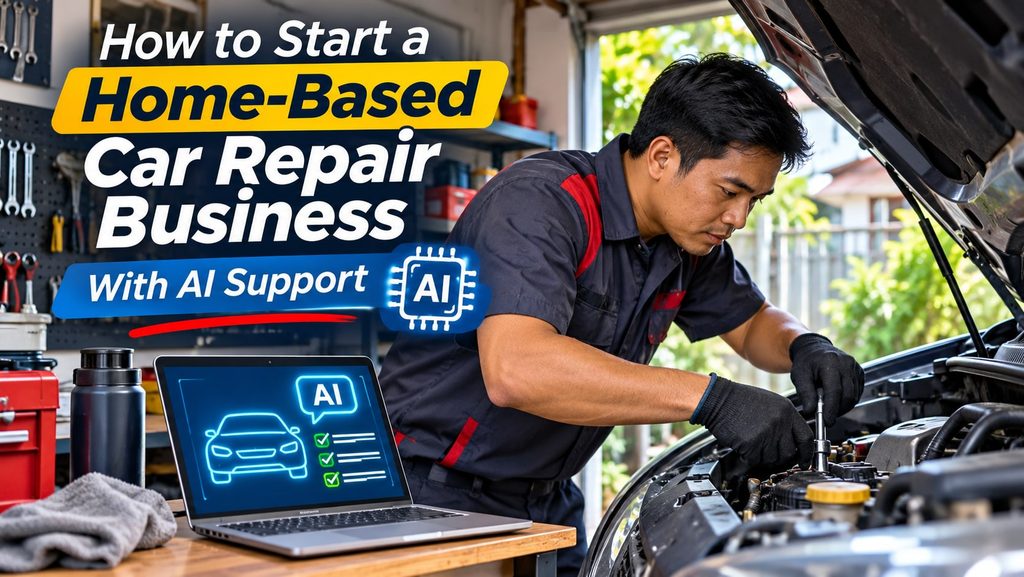
Could your garage become the base for a small automotive business? Start with the services you can safely deliver, not a promise to repair every vehicle.
For a trained mechanic in the Philippines, a home-based setup is worth exploring. AI can support preparation and customer conversations, but practical skills, suitable equipment, and business approvals still come first.
Choose a service you can deliver confidently
Write a short service menu based on your training and equipment. This might include replacing wiper blades or accessible cabin filters, following the correct procedures for each vehicle.
If you are still learning, start with training or non-repair support, such as organizing service records and coordinating workshop appointments. Do not charge customers for mechanical work you are not qualified to perform.
Establish a referral arrangement for jobs outside your competence. Brake, steering, airbag, and high-voltage work should never become experiments guided by a chatbot.
Test demand before buying equipment
Speak with nearby car owners about the jobs they struggle to arrange. Ask about appointment times, previous service experiences, and what would make them consider a new provider.
Choose one starting audience, such as Toyota owners within your neighborhood, rather than advertising repairs for every brand.
Prepare a list of interested customers before investing heavily. Their responses can help you decide which skills, tools, and services deserve priority.
Build relationships with a reliable parts supplier and a qualified workshop before launch. Confirm ordering times, return policies, and how referrals will be handled. Avoid filling shelves with parts for vehicles you have not booked. Order against approved work where practical, and clearly disclose any referral commission instead of presenting a paid recommendation as independent advice to the customer concerned.
Check whether your premises qualify
Before accepting paid repair work, confirm registration and operating requirements with the relevant authorities. In the Philippines, service and repair enterprises require DTI accreditation.
Ask your local government whether your proposed activity is permitted at the residential address, and confirm tax registration requirements with the BIR.
Discuss insurance, fire precautions, waste handling, and customer parking before committing to a workspace. Complete the applicable requirements rather than assuming a home business is exempt.
Use AI to prepare, not to guess
noMech offers an AI Mechanic chat and a maintenance plan based on a vehicle’s make, model, year, and mileage. Introduce it as an owner-facing planning aid, not diagnostic equipment or a replacement for inspection.
For Toyota customers, noMech’s guide to common Toyota problems provides background reading before a service discussion. Use it to identify topics to investigate, not to conclude that a listed problem affects every Toyota.
Invite the owner to describe when a symptom appears and review their service history together. Use the AI conversation to prepare follow-up questions.
Then verify technical recommendations against the manufacturer’s information and physical findings. Never authorize a repair or declare a vehicle safe solely because an app suggests it.
Create a repeatable booking process
Ask for the vehicle details, the customer’s description of the problem, and relevant service records before confirming an appointment. Explain what your service includes and what it does not.
Provide an itemized estimate covering parts, labor, and any agreed inspection charge. Obtain approval before starting, and contact the customer before adding work.
Afterward, document the work completed and explain anything unresolved. Keep customer information secure, and obtain permission before sharing their records with outside services or publishing photographs.
Price the whole job
Calculate more than the cost of replacement parts. Include consumables, preparation, administrative time, equipment upkeep, insurance, and other business expenses when setting your rates.
Keep business money separate from household spending. Record payments and costs for each booking, then review what remains after expenses.
Avoid advertising guaranteed savings or a fixed monthly income. Instead, test whether your prices cover the work required and whether customers consider the service worthwhile.
Build trust before expanding
Promote your actual service area, qualifications, opening hours, and clear pricing. Start with neighborhood groups where business posts are permitted, then ask satisfied customers for honest feedback.
Share useful explanations instead of dramatic claims about AI replacing mechanics. Be equally clear when a job needs a better-equipped workshop.
After your first bookings, review time spent, customer questions, referrals, and repeat visits. Expand only when your skills, workspace, and demand justify it.
A useful home-based automotive business combines competent work with clear communication. Let AI support those foundations, while you remain responsible for the services you sell.