
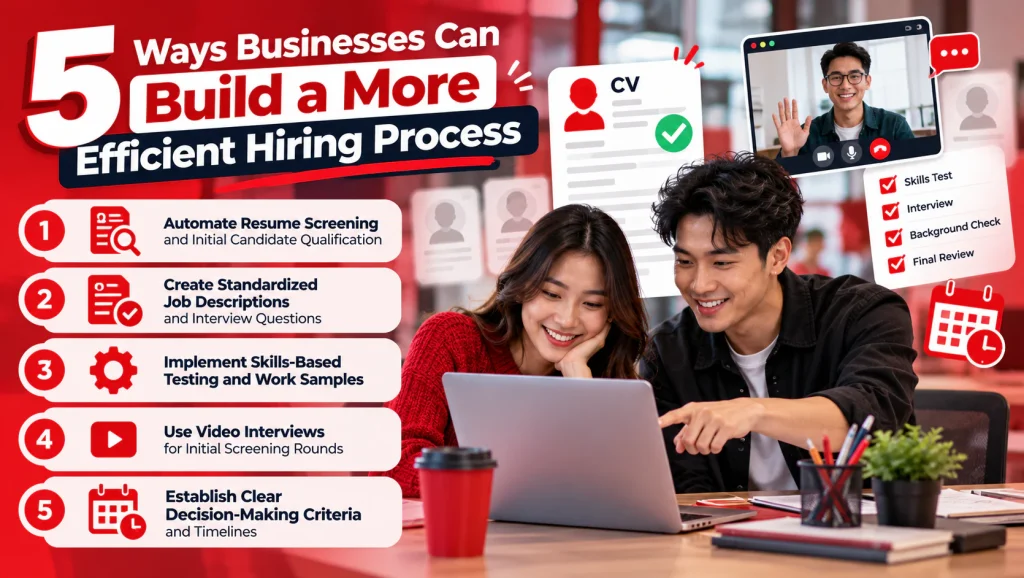
How much time does your company spend reviewing resumes, conducting interviews, and making hiring decisions? For many organizations, the recruitment process consumes weeks or even months per position, diverting resources from core business activities and delaying critical staffing needs. A more efficient hiring process does not just save time and money; it also improves the quality of hires by enabling hiring teams to focus on what matters most. Building streamlined recruitment workflows requires intentional changes to how companies source, screen, and evaluate candidates.
1. Automate Resume Screening and Initial Candidate Qualification
The early stages of recruitment often involve manually reviewing hundreds of resumes to identify candidates who meet basic requirements. This task is repetitive, time-consuming, and prone to human error. Implementing automated resume screening tools allows companies to quickly filter applications based on predetermined criteria such as specific keywords, years of experience, education level, and technical skills. These systems can categorize candidates into qualified, potentially qualified, and unqualified groups in a fraction of the time it would take a hiring manager to read each submission.
Automation at this stage does not eliminate human judgment; it enhances it by removing administrative burden. Hiring managers can then focus their attention on evaluating the most promising candidates rather than spending hours reading applications that do not match core requirements. For example, a company hiring for software engineers can set the system to flag candidates with specific programming languages or years of relevant experience. The result is a curated candidate pool that hiring teams can assess more thoughtfully and thoroughly.
2. Create Standardized Job Descriptions and Interview Questions
Vague or inconsistent job descriptions lead to mismatched candidate pools and wasted time during the interview process. When different hiring managers use different criteria or ask different questions, companies lose the ability to fairly compare candidates and often end up hiring based on subjective impressions rather than relevant qualifications. Developing standardized job descriptions that clearly outline role expectations, required qualifications, and preferred skills ensures that all applicants understand what the position entails. This clarity attracts candidates who genuinely fit the role and deters those who do not, reducing unnecessary applications.
Similarly, using a consistent set of interview questions across all candidates for a given position allows hiring teams to make meaningful comparisons. Structured interviews with predetermined questions result in more reliable assessments because each candidate responds to the same prompts. For instance, if a company is filling a customer service role, asking every candidate identical questions about conflict resolution and communication skills provides a fair basis for evaluation. This standardization also reduces unconscious bias in hiring decisions, improving both the efficiency and fairness of the process.
3. Implement Skills-Based Testing and Work Samples
Traditional interviews often do not accurately predict how well a candidate will actually perform in a role. Skills-based testing and work sample assignments provide concrete evidence of a candidate’s abilities before significant time investment in extended interviews. For example, a marketing agency could ask candidates to complete a sample campaign brief, while a design firm might request a portfolio review or a limited design project. These assessments reveal whether candidates possess the technical and practical capabilities required for success.
Work samples also benefit candidates by giving them a realistic preview of daily responsibilities, allowing them to demonstrate competency in an authentic context rather than through abstract interview questions. When companies incorporate these tools early in the hiring pipeline, they eliminate candidates who lack necessary skills and move forward only with those who have proven their capability. During this candidate vetting stage, teams often pair practical assessments with a social media background check to confirm that a candidate’s online presence aligns with the professionalism and values the role demands. This combined approach reduces the likelihood of poor hires and shortens the time spent interviewing candidates who may present well but lack practical expertise.
4. Use Video Interviews for Initial Screening Rounds
Scheduling in-person or video interviews with multiple candidates can become logistically complex, especially when coordinating across time zones or when candidates have limited availability. Asynchronous video interviews allow candidates to record responses to predetermined questions on their own schedule, which they can then submit for review. Hiring managers can watch these videos efficiently and decide which candidates warrant a live conversation. This format dramatically reduces scheduling friction while still allowing hiring teams to assess communication skills, personality, and how candidates articulate their experience.
Video screening also creates a record that multiple team members can review, which improves consistency in evaluation. A candidate who is convincing in a real-time conversation might not come across as well when reviewed by a hiring panel, and vice versa. By recording responses, teams eliminate the inconsistencies that arise when different people interview candidates at different times. Many candidates appreciate this option because they can prepare their answers thoughtfully rather than being put on the spot, leading to more authentic responses about their qualifications and motivation.
5. Establish Clear Decision-Making Criteria and Timelines
Hiring decisions sometimes drag on because no one has defined what constitutes a successful candidate or what timeline candidates can expect for each stage. When hiring teams lack clarity on priorities, interviews and deliberations become unnecessarily prolonged. Establishing explicit decision-making criteria before interviews begin, such as must-have skills, preferred qualifications, and culture fit indicators, enables hiring managers to quickly assess candidates against these benchmarks. Clear timelines also set expectations for both internal team members and external candidates, reducing uncertainty and improving the candidate experience.
Creating a defined hiring timeline with specific milestones ensures that decisions move forward promptly rather than stalling due to scheduling challenges or indecision. For instance, a company might establish that all first-round interviews will occur within one week of applications closing and that final candidates will be notified of hiring decisions within five business days of their final interview. This structure maintains momentum, keeps candidates engaged, and prevents top candidates from accepting offers elsewhere. When the entire organization understands the hiring timeline and decision criteria, the process moves smoothly and attracts candidates who appreciate a professional, organized recruitment experience.
Conclusion
Building a more efficient hiring process requires intentional investment in systems, standardization, and clarity. By automating initial screening, standardizing job descriptions and interviews, incorporating skills-based assessments, leveraging video screening tools, and establishing clear decision criteria, companies can dramatically reduce the time and resources spent on recruitment while simultaneously improving hire quality. These changes compound over time, creating a sustainable hiring operation that supports business growth without burdening internal teams. Organizations that prioritize hiring efficiency gain a competitive advantage in attracting talent and filling critical positions quickly, allowing them to focus resources on developing their workforce rather than constantly recruiting.


