
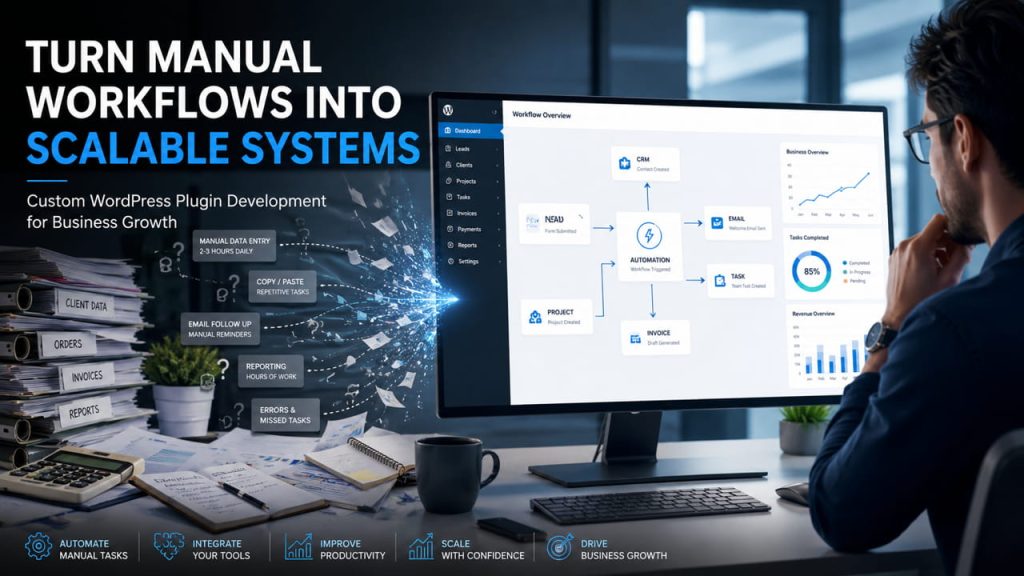
Every business develops its own way of doing things over time. You create processes for handling leads, managing inventory, onboarding clients, or tracking projects. These workflows are what make your company efficient. But when your website cannot support them properly, the friction starts to show. You end up with manual workarounds, spreadsheets, and disconnected tools. A professional WordPress plugin development service can change that. It takes your unique workflow and turns it into a custom, automated system that lives inside your WordPress site. The result is not just a plugin. It is a scalable foundation that grows with your business.
The Hidden Cost of Workflow Bottlenecks
Most businesses do not realize how much time they lose to small, repetitive tasks. Staff members copy data from one system to another. They manually format reports. They send the same emails over and over. These minutes add up to hours each week. Multiply that across a team, and the cost becomes significant.
Off-the-shelf plugins rarely solve the problem completely. They are built for a general audience. They might handle half your process but force you to adapt the other half. The remaining manual steps become a permanent annoyance. Over time, as transaction volume increases, those manual steps become a serious bottleneck. A custom plugin eliminates this entirely. It automates the full workflow exactly as your team needs it.
What a WordPress Plugin Development Service Actually Does
A WordPress plugin development service does more than write code. It starts with understanding your business deeply. Developers sit down with you to map out the exact workflow. They identify the inputs, the decision points, and the outputs. They ask about exceptions and edge cases. This discovery phase ensures the final product fits reality, not assumptions.
After that, the team designs the plugin architecture. They plan the database structure, the admin interfaces, and the user-facing components. They consider how the plugin will interact with other tools you use, like your CRM or email marketing platform. Only then does the actual coding begin. The service includes testing, documentation, and often training for your staff. The end deliverable is a fully functional plugin that integrates seamlessly into your WordPress dashboard.
Turning Manual Steps into Automated Systems
Take a common example like client onboarding. Without automation, a new client fills out a form. Someone on your team checks the entry, creates a project folder, sends a welcome email, schedules a kickoff call, and sets up an invoice. A custom plugin can chain all these actions together. The form submission triggers the folder creation, the email, the calendar event, and the invoice draft. Your team only steps in for the tasks that need a human touch.
This is the core transformation. The plugin does not just store data. It enforces your business rules. It routes information to the right people. It sends reminders when deadlines approach. It generates reports that show the status of everything at a glance. Your workflow becomes a system that runs in the background. Staff can focus on higher-value work instead of chasing administrative details.
Built to Scale with Your Business
A manual process that works for ten clients a month might collapse at a hundred. A spreadsheet that tracks fifty orders becomes a nightmare at five thousand. A custom plugin handles growth without breaking. Professional WordPress plugin development services build with scale in mind right from the start.
The database tables are designed for efficient queries even with large records. The code is modular, so adding new features later does not require a full rewrite. Caching is implemented for data that does not change often. If you launch a new product line or open a new location, the plugin can be extended to accommodate it. Your workflow system does not become obsolete when you succeed. It evolves alongside your business.
Integration with the Tools You Already Use
Your workflow likely spans multiple platforms. You might use an accounting software, a shipping provider, a learning management system, or a custom API. A generic plugin rarely connects to all of these smoothly. A custom plugin can integrate them directly. The development service builds the necessary API connections and data transformations.
For example, an e-commerce business might need their WordPress orders to sync with an inventory management system in real time. A custom plugin can push each order immediately after payment, updating stock levels and triggering warehouse pick lists. The integration happens silently. Staff see a unified view without logging into multiple dashboards. This connectivity eliminates data entry errors and keeps everyone working from accurate information.
Security and Maintainability as Core Principles
A plugin built to run a critical business workflow must be secure and maintainable. A professional service follows WordPress coding standards and best practices. They sanitize inputs, validate permissions, and use nonces for all requests. They write clean, well-documented code that another developer can understand and extend later.
They also plan for the future. WordPress core updates, PHP version upgrades, and other plugin interactions are all considered. The plugin is tested in staging environments before major updates. If a conflict arises, the development team can fix it quickly. You are not left stranded with a broken system that no one knows how to repair. This long-term reliability is a major reason businesses invest in a dedicated WordPress plugin development service instead of patching together free options.
Real Ownership and No Subscription Traps
Many commercial plugins charge recurring fees. The moment you stop paying, features lock up or the plugin stops receiving security patches. With a custom-built plugin, you own the code. There are no monthly subscriptions tied to the core functionality. You can host it on your server without license checks phoning home. You control the update schedule.
This ownership also means you can modify the plugin later. If your workflow changes, you hire a developer to adjust the code. You are not waiting for a third-party vendor to maybe add your requested feature someday. This independence is financially smarter in the long run and gives you true control over a vital business tool.
When to Choose a Custom Plugin Over an Off-the-Shelf Solution
Not every situation calls for a custom build. If your workflow is standard and a reliable plugin handles it completely, a pre-made solution makes sense. But consider a custom WordPress plugin development service when your process is unique, when no existing plugin fits, or when you are stitching multiple plugins together with fragile workarounds. Also consider it when your current system cannot handle the volume of data or transactions. The tipping point often comes when the cost of manual work and workarounds exceeds the investment in a proper solution.
Final Thoughts
Your workflow should not bend to fit the limitations of generic software. Your website should work the way your team thinks and operates. A professional WordPress plugin development service builds that bridge. It automates the tedious, enforces the important, and scales as you grow. The upfront investment pays back through time saved, errors reduced, and opportunities captured. Instead of managing a patchwork of half-solutions, you get a unified system that runs inside your familiar WordPress dashboard. That is the difference between surviving with ad-hoc tools and thriving with a scalable, purpose-built platform. When your workflow becomes a system, your business can focus on what truly matters: serving customers and growing sustainably.