
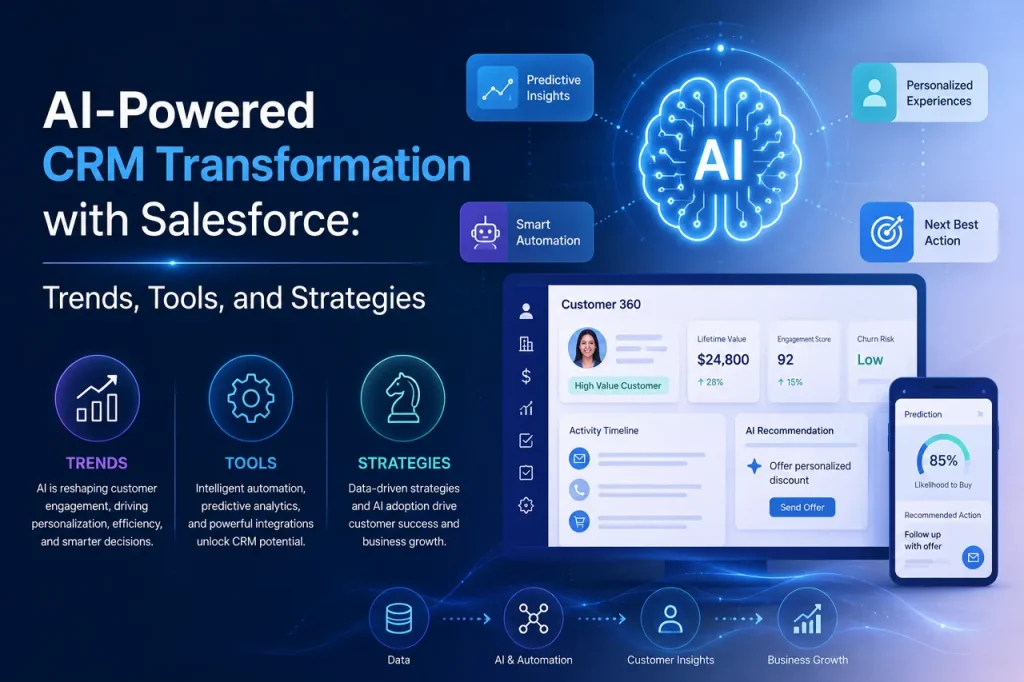
AI has changed the way CRM operates. What used to be a static database of contacts and deal stages is now a forecasting engine, one that watches, predicts, and often acts before an agent even opens the record. Salesforce, still the dominant name in the CRM space, hasn’t treated AI as a bolt-on feature either. It has now built much of the platforms around it. The practical result is a different approach to Salesforce CRM optimization: personalization that scales, decisions made in minutes, voice blast campaigns CRM, and results you can tie to revenue rather than just activity logs.
So, let’s understand in detail how businesses can achieve AI-powered CRM transformation with Salesforce. In addition, we’ll explore major trends, tools, and strategies and help you get the most out of your Salesforce investment.
The Evolution of CRM in the AI Era
Traditional CRM systems were essentially used as data entry. An agent closed a call, typed up notes, updated a stage, and moved on. Data quality depended entirely on human discipline, which, as in most cases, was unreliable or prone to error. CRM AI Services have transformed this approach by enabling AI-driven CRM systems to automatically track customer behavior, identify potential risks before a human notices them, and recommend the next best actions without being prompted. The major difference is that earlier CRM systems waited for instructions, whereas today’s smart CRMs proactively understand what needs to be done and help businesses make faster, more informed decisions.
Key AI Trends Transforming Salesforce CRM
There are some key AI trends that are helping Salesforce CRM perform the way it does, starting with personalization. It has moved from basic segmentation to building customer journeys around actual behavior—what someone clicked, bought, or ignored—rather than a broad category they happen to fall into. Forecasting has advanced just as much, with Salesforce predictive analytics enabling businesses to identify patterns, anticipate customer needs, and make more informed decisions. Predictive analytics can flag a customer who is likely to churn while there’s still time to intervene, and lifetime value estimates carry far more precision than they used to. By leveraging Salesforce predictive analytics, organizations can proactively optimize customer engagement, improve retention, and drive better business outcomes.
Another trend is that conversational tools have become standard tools with Chatbots and voice AI agents absorbing routine inquiries, which leaves human agents free for the harder cases that require judgment calls. Behind the scenes, automation handles lead scoring and service routing at a volume no team could manage manually. Also, the decision process itself has sped up with data-driven decision making. Dashboards refresh continuously, so a sales manager and a sales agent are looking at the same current numbers, not an outdated report.
What are Top AI-Powered Tools in Salesforce?
- The Einstein Lead Scoring solution can assist in identifying leads of high−value and identify deal risk, allowing agents to focus their time on the opportunities that have high chance of conversion.
- Einstein GPT can take just a few minutes to draft case summaries or reply to customer mails for agents, getting the message out more quickly and without repetitive writing for them.
- With Analytics Dashboards, crucial operational data is compressed into clear summaries, giving managers a simpler and easier to understand insight without requiring any technical skills.
- Flow Builder Automation is there to execute operational workflows seamlessly, eliminating the need for custom IT development and reducing bottlenecks.
Beyond Salesforce’s own toolkit, many enterprises extend their communication through AppExchange partners, particularly for Salesforce voicemail broadcast and mass calling Salesforce initiatives. Voice blast campaigns for CRM integrations let large sales teams reach broad customer segments quickly, with every call still logged and traceable inside the CRM record.
How to Drive Successful Salesforce CRM Optimization
01. Establish Data Readiness
Clean, structured, and compliant data is a must for AI systems as they’re completely dependent on the quality of the data they consume. Poor data management results in bad inputs, which gives rise to bad outputs. So:
- Audit current data sources
- Use consistent formats and layouts
- Make sure there are no infringements on the regulations.
02. Drive Change Management
When teams are used to the traditional workflow, they are not likely to blindly trust the recommendations made by the machine. To build confidence, you need training and reinforcement, and patience. Effective change management will help in driving adoption, and ensure your team sees AI as a support system than a competitor.
- Conduct hands on trainings
- Encourage gradual adoption
- Maintain trust and support with transparency
03. Scale Implementation Carefully
It’s better to launch AI across enterprise in phases rather than at once, reducing any exposure to risks at scale. Ensure both compliance and security are part of the workflow from the onset, this helps you avoid future penalties and protects brand credibility, avoiding regulatory exposure and loss of trust.
- Begin with small pilots
- Expand gradually after success
- Integrate compliance and security early
04. Fair & Transparent AI Usage
Using AI ethically and responsibly helps businesses reduce bias in outputs and prevent misuse. Also, when organizations are transparent about AI usage in their processes or services, it keeps the trust and confidence among customers and employees intact on how these AI-powered decisions are here to offer them benefit and not harm.
- Regularly review systems for bias
- Set clear guidelines on ethics early on
- Ensure transparency in decision-making processes
05. Focus on Stakeholder Alignment
Early inclusion of leadership with support and service teams minimizes friction. When they have a shared vision and objective from AI systems, it turns adoption collaborative, not competitive. Thus, ensuring investments are truly aligned with business priorities.
- Engage leadership early in planning
- Include frontline teams in discussions
- Align goals with measurable business outcomes
06. Commit to Continuous Optimization
AI systems need to be consistently monitored for performance, and not to be forgotten once they’re launched. On-going refinement is needed to maintain relevance, accuracy, and the consumer trust, with metrics and real user feedback driving improvements.
- Monitor performance metrics
- Gather user feedback regularly
- Adjust models and processes continuously
Conclusion: Where AI + Salesforce CRM is Headed
Autonomous agents capable of running full workflows with little human input are the likely next step. We should also expect that Generative AI will connect with live customer data more tightly, alongside stricter rules governing how that data gets used. Since AI has moved past being a Salesforce add-on, it’s now shaping what CRM is expected to deliver. By working with experienced Salesforce Consultants and investing in timely Salesforce CRM optimization, businesses will see the strongest returns and will find it much easier to adopt whatever comes after this.